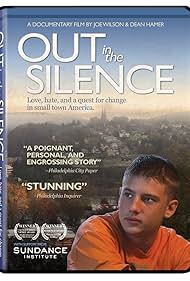
The announcement of filmmaker Joe Wilson's wedding to another man ignites a firestorm of controversy in his small hometown and a plea for help from the mother of a gay teen being tormented at school.
Keep track of everything you watch; tell your friends.
If your account is linked with Facebook and you have turned on sharing, this will show up in your activity feed. If not, you can turn on sharing
here
.
A gray winter sky hangs over lonely city streets, rotted oil derricks, and abandoned factories. This is Oil City, Pennsylvania, a fading industrial town in the heart of the American rust belt. It is the sort of town that Barrack Obama had in mind when he made his infamous comments about bitter small town residents clinging to their guns and religion as they watch the rest of the world pass them by. The peace and quiet is shattered when the filmmaker, Oil City native Joe Wilson, places the announcement of his wedding to another man in the local paper. The announcement catches the eye of Kathy Springer, a local woman whose teenage son, CJ, is being brutally tormented at school because he is gay. Ignored by the school authorities and with no where else to turn, she seeks help from Wilson and they begin a difficult but ultimately successful struggle to take on the school authorities who made every day "eight hours of pure hell" for CJ. The announcement has a very different effect on Diane... Written by
Dean Hamer
[first lines]
Joe Wilson:
I've lived in Washington, D.C. for twenty years. It's where I met Dean, playing pick-up basketball, and made a life for myself. But no matter how long you've been away from home or how much you've changed, the place, you were born and raised in, always stays some place deep inside. For me, that place is Oil City. A small town with small town values in the hills of western Pennsylvania.
See more »
as the other viewer says. What the other viewers say pretty much covers the film, I only want to draw attention to two things.
First, it is said that the harassment issue is not new, and it is not, yet it sounds as a nothing-new-under-the-sun drawback for the documentary; the fact that the boy's case is exemplary in his not being at all effeminate - exemplary, that is in vivifying the way we should think again what we see.
What I mean is this: take whatever film you will with man to man love, and tell me no matter how male the male element acts, to put it that way, homosexuality is usually depicted as a right to be admonished or not. But what CJ's case exemplifies is that all the babbling against homosexuality as sin boils down to reproduction: if you publicly act like like a, well, truly male male, who, literally, cares what you do between the sheets? What is missing from the covering of the facts is why CJ came out in the first place. Was it the usual "what bitch do you f**k" harassment, or like things one listens at high school? For the sake of privacy we won't know, but we can ponder upon it, that is what truly are the reasons of spelling out "who we are," that is our sexual identity.
That contrasts well with the female couple, that is their sexual identity as debate is irrelevant in terms of renovating a culturally important location, since that is what they do, significantly, for most of the film. Who we are is also what we offer to the community.
But of course this is something you know. Some pray for it, some pray against it.
I liked the nerve CJ brought to the film, I liked, well kind of, the chill that whatshername zealous woman allowed us to witness in the workings of gooood Christians, but the documentary relied a bit too much on them, I'd like to see some nerve from the makers, that is some accent on the emerging friendship between the pastor and the director as a true redeeming factor. That would sustain the tension and the care between leaving your hometown and staying there, as the director himself says towards the end.
2 of 5 people found this review helpful.
Was this review helpful to you?
as the other viewer says. What the other viewers say pretty much covers the film, I only want to draw attention to two things.
First, it is said that the harassment issue is not new, and it is not, yet it sounds as a nothing-new-under-the-sun drawback for the documentary; the fact that the boy's case is exemplary in his not being at all effeminate - exemplary, that is in vivifying the way we should think again what we see.
What I mean is this: take whatever film you will with man to man love, and tell me no matter how male the male element acts, to put it that way, homosexuality is usually depicted as a right to be admonished or not. But what CJ's case exemplifies is that all the babbling against homosexuality as sin boils down to reproduction: if you publicly act like like a, well, truly male male, who, literally, cares what you do between the sheets? What is missing from the covering of the facts is why CJ came out in the first place. Was it the usual "what bitch do you f**k" harassment, or like things one listens at high school? For the sake of privacy we won't know, but we can ponder upon it, that is what truly are the reasons of spelling out "who we are," that is our sexual identity.
That contrasts well with the female couple, that is their sexual identity as debate is irrelevant in terms of renovating a culturally important location, since that is what they do, significantly, for most of the film. Who we are is also what we offer to the community.
But of course this is something you know. Some pray for it, some pray against it.
I liked the nerve CJ brought to the film, I liked, well kind of, the chill that whatshername zealous woman allowed us to witness in the workings of gooood Christians, but the documentary relied a bit too much on them, I'd like to see some nerve from the makers, that is some accent on the emerging friendship between the pastor and the director as a true redeeming factor. That would sustain the tension and the care between leaving your hometown and staying there, as the director himself says towards the end.