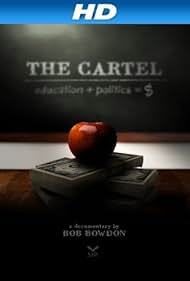
American public schools have been growing progressively worse. According to the U.S. Department of Education national testing, only 35% of American high school seniors are proficient in ... See full summary »
Keep track of everything you watch; tell your friends.
If your account is linked with Facebook and you have turned on sharing, this will show up in your activity feed. If not, you can turn on sharing
here
.
American public schools have been growing progressively worse. According to the U.S. Department of Education national testing, only 35% of American high school seniors are proficient in reading, based on 2006 data. And fewer than one-in-four, 23%, are proficient in math. On the global stage, America ranks last in educational effectiveness among large industrialized countries despite the highest spending per student in the world. It presents a conundrum: How has the richest and most innovative society on earth suddenly lost the ability to teach its children at a level that other modern countries consider "basic"? If the problem is that we're not spending enough on schools, which many people believe, it's instructive to study the U.S. state that spends more than any other per student: New Jersey With spending as high as $483,000 per classroom (confirmed by NJ Education Department records for 2005-06), New Jersey students fare only slightly better than the national average in reading and... Written by
Anonymous
Bob Bowdon, your host and interpreter, examines the New Jersey school system, trying to find out why it spends more money on public education than any other state and yet is so lousy.
He treats New Jersey as a microcosm of American education, which I'm not so sure is a hot idea, and has put together what looks like a TV special condemning just about every institution involved in educating the kids -- from teachers to the outfit that builds the buildings and steals the money.
It's a pretty dismal picture of phantom positions, dumb or abusive teachers, highly paid administrative staff that bloat the system, and just about everything else.
It's not so much an attack on the teachers themselves, although they don't escape unscathed. Most of them make what the rest of us would consider a normal middle-class salary. It's that the NJEA, the "cartel" of the title, is so powerful that it's damned near impossible to fire any of the tenured teachers, no matter how terrible they may be.
The problem seems to lie not so much in teacher competence but in the gargantuan bureaucracy whose chief purpose seems to be maintaining itself and making sure that the money keeps rolling in, even for staff members who don't exist. Corruption seems to be all over the place, like smallpox in a Medieval village.
I'd like to think Bowdon was exaggerating, that his flashy statistics and rapidly scanned headlines and anecdotal evidence were designed to paint a bleaker picture than exists. But he more or less convinced me of the general accuracy of the portrait. And he presents strong evidence that more money by itself won't solve the problem. My own research, in a different cultural region of the country, suggested as much.
But a fuller understanding would have been gotten if Bowdon had looked more closely at schools elsewhere, in other states, instead of concentrating so heavily on one notorious state, perhaps an outlier. And it would have been nice if he'd expanded his investigation outside of the school bureaucracy itself -- he'd convinced me early on that it was thoroughly rotten -- and looked at the broader society in which the school system operates. Regardless of the quality of the schools, how can you educate students who do not want to be educated and whose families don't care whether they are or not? What sort of tool, what kind of wrench, do you apply to community values? Here's another anecdote. I visited a store recently and the shop owner's son was outside polishing my car for a few dollars. It was a school day, and I asked why Ernest wasn't in class. His mother shrugged and said, "Oh, he doesn't like to go to school." I mention that incident because it illustrates what Bowdon has left out of his impassioned documentary.
0 of 0 people found this review helpful.
Was this review helpful to you?
Bob Bowdon, your host and interpreter, examines the New Jersey school system, trying to find out why it spends more money on public education than any other state and yet is so lousy.
He treats New Jersey as a microcosm of American education, which I'm not so sure is a hot idea, and has put together what looks like a TV special condemning just about every institution involved in educating the kids -- from teachers to the outfit that builds the buildings and steals the money.
It's a pretty dismal picture of phantom positions, dumb or abusive teachers, highly paid administrative staff that bloat the system, and just about everything else.
It's not so much an attack on the teachers themselves, although they don't escape unscathed. Most of them make what the rest of us would consider a normal middle-class salary. It's that the NJEA, the "cartel" of the title, is so powerful that it's damned near impossible to fire any of the tenured teachers, no matter how terrible they may be.
The problem seems to lie not so much in teacher competence but in the gargantuan bureaucracy whose chief purpose seems to be maintaining itself and making sure that the money keeps rolling in, even for staff members who don't exist. Corruption seems to be all over the place, like smallpox in a Medieval village.
I'd like to think Bowdon was exaggerating, that his flashy statistics and rapidly scanned headlines and anecdotal evidence were designed to paint a bleaker picture than exists. But he more or less convinced me of the general accuracy of the portrait. And he presents strong evidence that more money by itself won't solve the problem. My own research, in a different cultural region of the country, suggested as much.
But a fuller understanding would have been gotten if Bowdon had looked more closely at schools elsewhere, in other states, instead of concentrating so heavily on one notorious state, perhaps an outlier. And it would have been nice if he'd expanded his investigation outside of the school bureaucracy itself -- he'd convinced me early on that it was thoroughly rotten -- and looked at the broader society in which the school system operates. Regardless of the quality of the schools, how can you educate students who do not want to be educated and whose families don't care whether they are or not? What sort of tool, what kind of wrench, do you apply to community values? Here's another anecdote. I visited a store recently and the shop owner's son was outside polishing my car for a few dollars. It was a school day, and I asked why Ernest wasn't in class. His mother shrugged and said, "Oh, he doesn't like to go to school." I mention that incident because it illustrates what Bowdon has left out of his impassioned documentary.