| Cast overview, first billed only: | |||
|
|
Lu Huang | ... | |
|
|
Youan Yang | ... |
Huang Degui
|
|
|
Yuling Zhang | ... |
Ding Xiuying
|
|
|
Yunle He | ... |
Huang Decheng
|
|
|
Yingao Jia | ... |
Huang Changyi
|
|
|
Youping Zhang | ... |
Li Qingshan
|
|
|
Ai Chen | ... |
Chen Chunli
|
|
|
Hui Huang | ... |
Hu Xiaoxiao
|
|
|
Yang Li | ... |
Wu Maoxiang
|
|
|
Wenguang Zhu | ... |
Police Officer Zhu
|
|
|
Yang Fan | ... |
Police Officer Sun
|
|
|
Zhishun Yuan | ... |
Bai Yanfeng
|
|
|
Xiaoli Zou | ... |
Village Chief
|
|
|
Yi Quan | ... |
Huang Jianshe
|
|
|
Li Dai | ... |
Huang Jiaxing
|
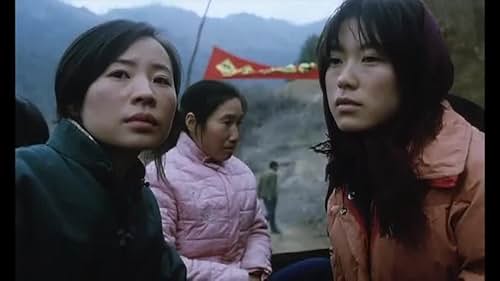
China, the 1990s. In villages where female babies are drowned, there are few young women to marry the men and bear more sons. Families buy wives - girls lured from the city. Bai finishes college and accepts a job in a remote mountain village harvesting herbs. It's a ruse: she's sold to a peasant family. She's indignant; the parents hold her so the son can rape her. She tries to run away; she's beaten. Other women kidnapped a few years before, now with children, tell her to comply. She continues to try to escape. She writes to her father, smuggling letters to the mailman. She obtains a bit of money. The village is without pity, except for the teacher. Can he help her? Anger mounts. Written by <jhailey@hotmail.com>
The style reminded me so much of Zhang Yimou's "Not One Less" - the way that it was directed with nonactors (only two of the characters were professional actors), the teaching of school children in the country side, and the contrast between the lifestyles of rural and urban China. In fact, I'm pretty sure that one of the locations in the city is a location in Not One Less the broadcast station. I'm wondering whether or not the obvious influences are intentional, since this movie seemed to be receiving warm praise. I would hate to learn that the director did not realize the similarities between this and Not One Less, since Zhang Yimou's present influence seemed to be somewhat overt to me. The way in which it is shot mostly with wide lenses with a deemphasis on the shot in order to normalize and situate the film as a socialistic commentary on modern day China definitely owes much to the 5th gen directors Zhang Yimou, Chen Kaige, and others (at least in my opinion). I don't think this film is anywhere near the level that those experienced veterans are used to making, but it's a good effort. I think the biggest thing that it lacks is fluency between scenes and I think that that is a burden the actors have to carry. It's difficult to direct nonactors (imagine being abducted to act for a month, i'm surprised they weren't terrified 100% of the time). He actually used real policemen, hospital workers, and rural villagers and although they don't have to pretend to be anyone other than themselves, it can be dangerous if these characters have a presence in the movie because they have to be able to carry on the story in their own way as well. Even minor roles have motivations and emotional arcs, but it seems as if these people have lost them, and are acting from a shot to shot basis without any idea of how the overall story is like. I'm glad I got to see this film though, despite the acting, because it gives me a chance to see how important the element of directing your actors are. And I definitely respect the choice of using nonactors. It seems to be a characteristic feature of many of these kinds of international films. Besides, these people have a realistic understanding of the micro-cosmic world of which we so easily play critic from afar. You just have to know how to tap into it.