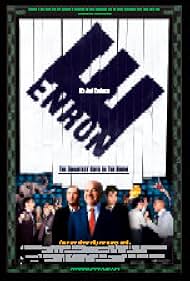
Corporate audio and videotapes tell the inside story of the scandal involving one company's manipulation of California's energy supply and its, and how its executives wrung a billion dollars out of the resulting crisis.
Keep track of everything you watch; tell your friends.
If your account is linked with Facebook and you have turned on sharing, this will show up in your activity feed. If not, you can turn on sharing
here
.
Based on the best-selling book of the same name by Fortune reporters Bethany McLean and Peter Elkind, a multidimensional study of one of the biggest business scandals in American history. The chronicle takes a look at one of the greatest corporate disasters in history, in which top executives from the 7th largest company in this country walked away with over one billion dollars, leaving investors and employees with nothing. The film features insider accounts and rare corporate audio and video tapes that reveal colossal personal excesses of the Enron hierarchy and the utter moral vacuum that posed as corporate philosophy. The human drama that unfolds within Enron's walls resembles a Greek tragedy and produces a domino effect that could shape the face of our economy and ethical code for years to come. Written by
Sujit R. Varma
Among the protesters who disrupt the meeting with Jeff Skilling at San Francisco's Commonwealth Club is Marla Ruzicka, who was killed on 16 April 2005 in Iraq by a suicide bomber. She founded CIVIC (Campaign for Innocent Victims of Conflict) which worked to help the victims of the war in Iraq and she was a former Global Exchange activist. See more »
Quotes
Jeff Skilling:
[comparing California to the Titanic]
At least when the Titanic went down, the lights were on.
See more »
Crazy Credits
Special thanks includes "all the `Deep Throats' - you know who you are!" See more »
"Capitalism"
Written by Danny Elfman (as Daniel Elfman)
Little Maestro Music
Performed by Oingo Boingo
Courtesy of A&M Records under license from Universal Music Enterprises See more »
One powerful theme in "The Smartest Guys in the Room" is expressly articulated and repeated for emphasis: this is the story of people, not arcane financial accounting methods or numbers, and because it is people, it can happen again. Enron is just the manifestation of the evil begotten by hubris, in spectacularly public fashion. It is classic Greek tragedy, and it is one from which its chief protagonists, Ken Lay and Jeff Skilling, must not escape.
Yes, it is a movie with a point of view, but this is not a Michael Moore documentary. Director Alex Gibney brilliantly tells the story simply by interviewing people who were participants in the events, showing the time lines of those events, and interweaving an astonishing amount of video and audio footage taped at Enron, by Enron itself. The movie resolved for me the question: "What did they know, and when did they know it?" They knew. They not only knew; they designed the company to be the ultimate shell game, with no pea. The only thing Enron ever had to sell was its stock price. And they did know that was their only product.
As a Houstonian, I admit that I, a supposedly sophisticated business professional, was intimidated by Enron's assertion in its glory days that the reason I didn't understand its business was just that I wasn't smart enough. My friends, managers and lawyers, some from Harvard thenselves, also admit to the same intimidation. It was not that the questions were not being asked; it was just that we were silenced when Enron avowed that they were the smartest guys in the room. They asserted it, and we believed them. Thank good Fortune that one reporter, Bethany McLean, in almost too soft a voice to be credible as a giant killer, kept asking.
I wish this movie might inspire a larger remedy than the one being attempted by the Department of Justice. Why doesn't Harvard deny admission to people like Jeff Skilling, who, when questioned in his entrance interview whether he was smart, replied, "I'm (expletive deleted) smart"? Why isn't some humility and modesty still ranked a virtue? Why do we celebrate the rise of the specialist educated only in his field, and wholly ignorant of the inevitability of the fall of the Greek protagonist who becomes blinded by arrogance, power, greed---- in short, hubris? Why is ethics a specialty study, instead of integral to every field of study? I sat open-mouthed as the tape showed Jeff Skilling seriously selling a new business idea: selling futures in the weather. He parodied himself on tape: he had a new, better idea than the "mark to market" booking which allowed Enron to book future theoretical profits once they had signed a deal; now he would institute "hypothetical to book", booking profits as soon as he had an idea. What, ultimately, was the difference between the parody and the reality? The horror of listening to traders, who sat in a room directly below Ken Lay and Jeff Skilling, with staircases between their executive offices and the trading floor, laughing at the misery they were inflicting on California as they extorted profits from that misery, leaves me outraged long after the movie is over. They threatened and may have cost lives with their fraudulent tactics. They admit it on tape, laughing. They knew. It was their business plan. To make Andrew Fastow the scapegoat for what Enron was developing as its business plan before he was ever hired is simply the continuation of the shell game with no pea. Look for the "designated fall guy". They still think they are the smartest guys in the room.
No, I'll never be selected for the jury pool now, but I wouldn't have been anyway. I'll buy the DVD and watch it a few times during the trials and seethe, lest I forget. Excellent movie, the best kind of documentary.
84 of 89 people found this review helpful.
Was this review helpful to you?
One powerful theme in "The Smartest Guys in the Room" is expressly articulated and repeated for emphasis: this is the story of people, not arcane financial accounting methods or numbers, and because it is people, it can happen again. Enron is just the manifestation of the evil begotten by hubris, in spectacularly public fashion. It is classic Greek tragedy, and it is one from which its chief protagonists, Ken Lay and Jeff Skilling, must not escape.
Yes, it is a movie with a point of view, but this is not a Michael Moore documentary. Director Alex Gibney brilliantly tells the story simply by interviewing people who were participants in the events, showing the time lines of those events, and interweaving an astonishing amount of video and audio footage taped at Enron, by Enron itself. The movie resolved for me the question: "What did they know, and when did they know it?" They knew. They not only knew; they designed the company to be the ultimate shell game, with no pea. The only thing Enron ever had to sell was its stock price. And they did know that was their only product.
As a Houstonian, I admit that I, a supposedly sophisticated business professional, was intimidated by Enron's assertion in its glory days that the reason I didn't understand its business was just that I wasn't smart enough. My friends, managers and lawyers, some from Harvard thenselves, also admit to the same intimidation. It was not that the questions were not being asked; it was just that we were silenced when Enron avowed that they were the smartest guys in the room. They asserted it, and we believed them. Thank good Fortune that one reporter, Bethany McLean, in almost too soft a voice to be credible as a giant killer, kept asking.
I wish this movie might inspire a larger remedy than the one being attempted by the Department of Justice. Why doesn't Harvard deny admission to people like Jeff Skilling, who, when questioned in his entrance interview whether he was smart, replied, "I'm (expletive deleted) smart"? Why isn't some humility and modesty still ranked a virtue? Why do we celebrate the rise of the specialist educated only in his field, and wholly ignorant of the inevitability of the fall of the Greek protagonist who becomes blinded by arrogance, power, greed---- in short, hubris? Why is ethics a specialty study, instead of integral to every field of study? I sat open-mouthed as the tape showed Jeff Skilling seriously selling a new business idea: selling futures in the weather. He parodied himself on tape: he had a new, better idea than the "mark to market" booking which allowed Enron to book future theoretical profits once they had signed a deal; now he would institute "hypothetical to book", booking profits as soon as he had an idea. What, ultimately, was the difference between the parody and the reality? The horror of listening to traders, who sat in a room directly below Ken Lay and Jeff Skilling, with staircases between their executive offices and the trading floor, laughing at the misery they were inflicting on California as they extorted profits from that misery, leaves me outraged long after the movie is over. They threatened and may have cost lives with their fraudulent tactics. They admit it on tape, laughing. They knew. It was their business plan. To make Andrew Fastow the scapegoat for what Enron was developing as its business plan before he was ever hired is simply the continuation of the shell game with no pea. Look for the "designated fall guy". They still think they are the smartest guys in the room.
No, I'll never be selected for the jury pool now, but I wouldn't have been anyway. I'll buy the DVD and watch it a few times during the trials and seethe, lest I forget. Excellent movie, the best kind of documentary.