I'm always surprised about how many times you'll see something about World War 2 on the German national television. You would think they don't like to open old wounds, but there isn't a week that goes by without a documentary or a movie about the horror and atrocities of this war. Perhaps it's a way of dealing with their past, I don't know, but you sure can't blame them of ignoring what happened. And it has to be said: most of those documentaries are really worth a watch because they never try to gloss over the truth and the same can be said about their movies (think for instance about "Der Untergang" or "The Downfall" as you might now it) which are also very realistic.
One of those movies is "Rosenstrasse". It tells a true story and deals with the subject of the mixed marriages during the war, even though the movie starts with a family in the USA, at the present day. After Hannah's father died, her mother all a sudden turned into an orthodox Jew even though she hasn't been very religious before. She doesn't know where the strange behavior of her mother comes from, but as she starts digging in her mother's troubled childhood, Hannah understands how little she has ever known about her mother's past.
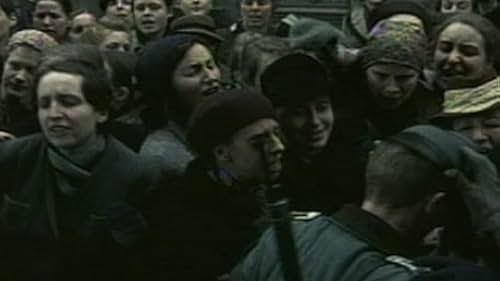
The fact that this movie deals with the subject of the mixed marriages during the Nazi regime is already quite surprising. For as far as I know, there hasn't been another movie that deals with this subject. (For those who didn't know this yet: Being married to a so-called pure Aryian man or woman meant for many Jews that they weren't immediately sent to one of the concentration camps, but that they had to work in a factory). But it does not only tell something about the problems of the mixed marriages, it also gives a good idea of how these people were often seen by their own parents and relatives. How difficult it sometimes was for them during the Nazi regime and how these people, most of the time women, did everything within their power to free their men, once they were captured and locked away in for instance the Rosenstrasse...
The acting is really good and the story is very well written, although the way it was presented in the beginning didn't really do it for me (and that's exactly the only part that you'll get to see in the trailer). Perhaps it's just me, but I would have left out a big part of what happens in the present day. At least of the part that is situated in the USA, because the part where Hannah goes to Berlin and talks to someone who knows more about her mother's past, definitely works.
If you are interested in everything that has something to do with the Second World War, and if you aren't necessarily looking for a lot of action shots, than this is definitely a movie you should see. This isn't a movie in which you'll see any battles or gunfights, but it certainly is an interesting movie, because it gives you an idea about an aspect of the war only little is known of. I give it an 8/10.