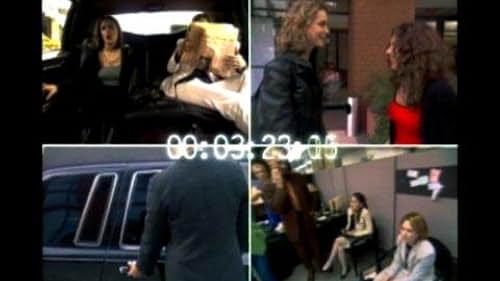
Four frames of simultaneous action that alternately follow a smitten lesbian lover as she obsesses over her partner's dalliances and the tense goings-on of a Hollywood film production company.
Keep track of everything you watch; tell your friends.
If your account is linked with Facebook and you have turned on sharing, this will show up in your activity feed. If not, you can turn on sharing
here
.
Confused, non-linear film tells the sexual story of a film director from his life at age 5, age 12, age 16, a man embarking on his first film in 1950's Tunisia, and finally to his current ... See full summary »
The story of how the novel "Mrs. Dalloway" affects three generations of women, all of whom, in one way or another, have had to deal with suicide in their lives.
Upon admittance to a mental institution, a brash rebel rallies the patients to take on the oppressive head nurse, a woman he views as more dictator than nurse.
Director:
Milos Forman
Stars:
Michael Berryman,
Peter Brocco,
Louise Fletcher
L.A., real time. From her limo, the wealthy Lauren eavesdrops on her lover Rose's tryst with movie producer Alex Green. The assignation takes place in his company's screening room between meetings. Alex's wife walks from therapy to his office, tells him she's leaving him, weeps in a bookstore restroom, and walks home with a cocaine-sniffing actress friend for what may lead to sex. Alex is drinking, wants to quit work and move to Tuscany, laughs at pretentious movie pitches, and puts off Rose when she asks for an audition. A film director sees Rose and decides she's perfect for his next picture; she takes a screen test. She's ecstatic and calls Lauren: jealousy takes over. Written by
<jhailey@hotmail.com>
There is a rule in science that for an experiment to be meaningful, all the variables must be controlled but one. That rule could be applied to experimental cinema, too; at least it should have been applied to this film.
Time Code combines two experiments, one that has promise, and one that is doomed. The promising experiment involves multiple screens following different parts of the story in "real" time. The doomed experiment involves requiring actors to script and direct themselves.
In addition, this movie was shot in four simultaneous uninterrupted takes. Maybe this was an experiment, too, but it is comparable to live theater, which is not exactly a novelty. It is neither a good thing nor a bad thing -- and should be a matter of complete indifference to the audience, as long it works. Instead of cutting from scene to scene, our attention shifts from screen to screen.
The four-screen experiment did work reasonably well here, especially on DVD, where one can instantly back up to catch bits one missed. The multi-view device might even have been truly excellent in this film, had it not been for the other experiment -- the Absentee Director.
A feature movie is not an improv sketch. There is a reason that an army has one general, and that a movie has one director. Although each of these endeavors requires the effort and cooperation of many talented people, both a military campaign and a feature film must be focused on one person's vision and goals.
Time Code has the same fatal flaw as Dancing at the Blue Iguana. Each actor was instructed to invent his own character, and then to direct himself. In Time Code each performer was evidently told to make of his character a recognizable Hollywood stereotype. The result: eight variations on "coke-snorting pretentious but sycophantic loser," who all walk stiffly through their parts like zombies trying to perform soap opera. I cannot imagine how desperate a viewer would have to be, in order to care about any of them.
I suppose this should not reflect badly on the performers, although it cannot have helped their careers. I have seen most of them in other films, and they are all capable actors. It does reflect dismally on the director. Where was he hiding while the four cameras were running? Maybe he was busy watching four tumble dryers at the laundromat up the street.
Time Code might be worth a peek on dollar-day at the video store -- which is how I found it. Otherwise, forget it. 3/10.
13 of 17 people found this review helpful.
Was this review helpful to you?
There is a rule in science that for an experiment to be meaningful, all the variables must be controlled but one. That rule could be applied to experimental cinema, too; at least it should have been applied to this film.
Time Code combines two experiments, one that has promise, and one that is doomed. The promising experiment involves multiple screens following different parts of the story in "real" time. The doomed experiment involves requiring actors to script and direct themselves.
In addition, this movie was shot in four simultaneous uninterrupted takes. Maybe this was an experiment, too, but it is comparable to live theater, which is not exactly a novelty. It is neither a good thing nor a bad thing -- and should be a matter of complete indifference to the audience, as long it works. Instead of cutting from scene to scene, our attention shifts from screen to screen.
The four-screen experiment did work reasonably well here, especially on DVD, where one can instantly back up to catch bits one missed. The multi-view device might even have been truly excellent in this film, had it not been for the other experiment -- the Absentee Director.
A feature movie is not an improv sketch. There is a reason that an army has one general, and that a movie has one director. Although each of these endeavors requires the effort and cooperation of many talented people, both a military campaign and a feature film must be focused on one person's vision and goals.
Time Code has the same fatal flaw as Dancing at the Blue Iguana. Each actor was instructed to invent his own character, and then to direct himself. In Time Code each performer was evidently told to make of his character a recognizable Hollywood stereotype. The result: eight variations on "coke-snorting pretentious but sycophantic loser," who all walk stiffly through their parts like zombies trying to perform soap opera. I cannot imagine how desperate a viewer would have to be, in order to care about any of them.
I suppose this should not reflect badly on the performers, although it cannot have helped their careers. I have seen most of them in other films, and they are all capable actors. It does reflect dismally on the director. Where was he hiding while the four cameras were running? Maybe he was busy watching four tumble dryers at the laundromat up the street.
Time Code might be worth a peek on dollar-day at the video store -- which is how I found it. Otherwise, forget it. 3/10.