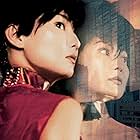
He was a writer. He thought he wrote about the future but it really was the past. In his novel, a mysterious train left for 2046 every once in a while. Everyone who went there had the same ... See full summary »
Keep track of everything you watch; tell your friends.
If your account is linked with Facebook and you have turned on sharing, this will show up in your activity feed. If not, you can turn on sharing
here
.
Spanning over one thousand years, and three parallel stories, The Fountain is a story of love, death, spirituality, and the fragility of our existence in this world.
A couple undergo a procedure to erase each other from their memories when their relationship turns sour, but it is only through the process of loss that they discover what they had to begin with.
Director:
Michel Gondry
Stars:
Jim Carrey,
Kate Winslet,
Gerry Robert Byrne
Eun-joo moves out of her house "Il Mare", leaving behind a Christmas card for the eventual new owner of the house in 1999. In it she asks him/her to forward any mail of hers to her new ... See full summary »
He was a writer. He thought he wrote about the future but it really was the past. In his novel, a mysterious train left for 2046 every once in a while. Everyone who went there had the same intention.....to recapture their lost memories. It was said that in 2046, nothing ever changed. Nobody knew for sure if it was true, because nobody who went there had ever come back- except for one. He was there. He chose to leave. He wanted to change. Written by
chicken noodles
The director declined the invitation to screen the film in the New York Film Festival. See more »
Quotes
Bai Ling:
I don't get it. Were does all that fun get you? If you find the right person, why waste time on the others?
Chow Mo Wan:
If I find the right person? A man like me has nothing much except free time. That's why I need company.
Bai Ling:
So people are just time fillers to you?
Chow Mo Wan:
I wouldn't say that. Other people can borrow my time to.
Bai Ling:
And tonight? Are you borrowing me, or am I borrowing you?
Chow Mo Wan:
No difference. Maybe I borrowed you earlier, now you're borrowing me.
Bai Ling:
Ridiculous.
See more »
I read different takes on 2046 and its connection to its predecessor by writer/director Wong Kar-Wai, In the Mood for Love. Some said you had to see it before 2046, although the general consensus was that the unusual romanticism and little details in both films, and actors like Tony Leung and Maggie Chung, made the only real connection(s) (Wong himself has said ironically to see 2046 before In the Mood for Love). It seems, after seeing the film, that he was correct; I had seen half of In the Mood for Love a while back, and I did get an idea of what I might expect, but the fact is is that 2046 really does work fine as a film on its own terms. It's a story that at first seems like it will be style over substance, and at times it is, but the substance is usually very intriguing, and keeps attention. It isn't a perfect film, and towards the end it starts to lag, but such criticisms are made up for by the attributes.
We learn from the narrator and lead character, Chow (Leung), that there is a place, if not a time, called 2046, where people don't leave unless they fall in love. But, for the bulk of the film, the film is not set in any kind of futuristic setting that might be assumed on the outset of going into the film. It's set in late 60's Hong Kong, where Chow writes lurid fantasy stories. He takes room 2046 after seeing a woman, Su (Li Gong), in the room. He feels that this place is where he, like others, can go to "lose memories" ("All memories are traces of tears", a title-card reads), which spurs him on the start writing a sci-fi novel with the room's title.
During his stay, he meets two women that effect him: an abused girl, at first acting aloof, Lulu/Mimi (Carina Lau), leaves and the later comes back in the film as a kind of writing assistant for Chow. The more significant woman, however, is in the form of call-girl Bai Ling (Zhang Ziyi, a woman so gorgeous it borders on the unreal), who like the others takes room 2047, and becomes Chow's "drinking buddy". But this soon turns to playfulness, to a side affair. Although there is much else that goes on in the film, this has some of the best material, with wonderful dialog and style giving room for perhaps th best performance I've seen from Ziyi yet.
This is not all to the film, though it could've been and been as successful. The women in Wong's films, like with Hitchcock or even Antonioni or Godard (all directors he was obviously inspired by for his own original stance), are crucial to how it turns out. These women express everything Wong desires, abandons, represses, flirts, and acts cool with. They spur on almost every one of his creative pieces (he gives a short story of 2047 to one, who wonders why the ending is so sad, to which he cannot create a happy one), and all of the things he'd rather not forget. Without the strong performances from them all, in particular Ziyi, Lau and Cheung, the drama just wouldn't be there, and certainly the style giving much weight to the film would become over-cooked and pretentious.
The style, of which, was something I took various notes of while I watched, scribbling bits, elements, colors and shots that caught my eyes: the greens in the halls, the brightness of outside on the porch, the black and white scene in the cab (one of my favorites), and of course the futuristic visualization scenes of Chow's own 2046. What's curious about the real sci-fi type scenes is that they make little sense aside from the central point- finding real love and the exile following- but the atmosphere, use of different colors and shots and film speeds (Christopher Doyle, a DP on most of Wong's films, does beautiful work all around) is unique, and basically saves a dramatically empty sequence.
There is also the question of slow-motion, which is used to much more effect than in the previous Wong films I've seen, and if it is over-used. It becomes a distraction only towards the end, when one wishes things were not TOO romanticized, but many times it is affecting, and tries to past the melodrama in some of the (above average) writing. Overall, Wong Kar-Wai displays without a shadow of doubt with 2046 that he is a master of compositions, of moods, and of creating characters that are true to themselves, who feel and love but can't seem to reach for it. But this doesn't make it an 'empty' film. If a scene missteps or something gets irksome with the style, it comes back around at the next minutes.
36 of 51 people found this review helpful.
Was this review helpful to you?
I read different takes on 2046 and its connection to its predecessor by writer/director Wong Kar-Wai, In the Mood for Love. Some said you had to see it before 2046, although the general consensus was that the unusual romanticism and little details in both films, and actors like Tony Leung and Maggie Chung, made the only real connection(s) (Wong himself has said ironically to see 2046 before In the Mood for Love). It seems, after seeing the film, that he was correct; I had seen half of In the Mood for Love a while back, and I did get an idea of what I might expect, but the fact is is that 2046 really does work fine as a film on its own terms. It's a story that at first seems like it will be style over substance, and at times it is, but the substance is usually very intriguing, and keeps attention. It isn't a perfect film, and towards the end it starts to lag, but such criticisms are made up for by the attributes.
We learn from the narrator and lead character, Chow (Leung), that there is a place, if not a time, called 2046, where people don't leave unless they fall in love. But, for the bulk of the film, the film is not set in any kind of futuristic setting that might be assumed on the outset of going into the film. It's set in late 60's Hong Kong, where Chow writes lurid fantasy stories. He takes room 2046 after seeing a woman, Su (Li Gong), in the room. He feels that this place is where he, like others, can go to "lose memories" ("All memories are traces of tears", a title-card reads), which spurs him on the start writing a sci-fi novel with the room's title.
During his stay, he meets two women that effect him: an abused girl, at first acting aloof, Lulu/Mimi (Carina Lau), leaves and the later comes back in the film as a kind of writing assistant for Chow. The more significant woman, however, is in the form of call-girl Bai Ling (Zhang Ziyi, a woman so gorgeous it borders on the unreal), who like the others takes room 2047, and becomes Chow's "drinking buddy". But this soon turns to playfulness, to a side affair. Although there is much else that goes on in the film, this has some of the best material, with wonderful dialog and style giving room for perhaps th best performance I've seen from Ziyi yet.
This is not all to the film, though it could've been and been as successful. The women in Wong's films, like with Hitchcock or even Antonioni or Godard (all directors he was obviously inspired by for his own original stance), are crucial to how it turns out. These women express everything Wong desires, abandons, represses, flirts, and acts cool with. They spur on almost every one of his creative pieces (he gives a short story of 2047 to one, who wonders why the ending is so sad, to which he cannot create a happy one), and all of the things he'd rather not forget. Without the strong performances from them all, in particular Ziyi, Lau and Cheung, the drama just wouldn't be there, and certainly the style giving much weight to the film would become over-cooked and pretentious.
The style, of which, was something I took various notes of while I watched, scribbling bits, elements, colors and shots that caught my eyes: the greens in the halls, the brightness of outside on the porch, the black and white scene in the cab (one of my favorites), and of course the futuristic visualization scenes of Chow's own 2046. What's curious about the real sci-fi type scenes is that they make little sense aside from the central point- finding real love and the exile following- but the atmosphere, use of different colors and shots and film speeds (Christopher Doyle, a DP on most of Wong's films, does beautiful work all around) is unique, and basically saves a dramatically empty sequence.
There is also the question of slow-motion, which is used to much more effect than in the previous Wong films I've seen, and if it is over-used. It becomes a distraction only towards the end, when one wishes things were not TOO romanticized, but many times it is affecting, and tries to past the melodrama in some of the (above average) writing. Overall, Wong Kar-Wai displays without a shadow of doubt with 2046 that he is a master of compositions, of moods, and of creating characters that are true to themselves, who feel and love but can't seem to reach for it. But this doesn't make it an 'empty' film. If a scene missteps or something gets irksome with the style, it comes back around at the next minutes.