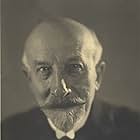
Even though it's only 1898, filmmaker Georges Méliès is already starting to move beyond the substitution splice which made possible the various spectacular illusions on film which he produced. "The Four Troublesome Heads" not only uses such an effect, it also continues on to employ multiple exposures (or superimposing) to create even crazier illusions which are amazing for the time. In this brief film, director Méliès stars as a magician or prestidigitator who is able to detach his head from his shoulders and set it on a table, where it is able to converse with the magician in an amusingly delightful way. He continues to repeat the same illusion until there are three heads on two tables which are able to perform a sing-a-long with the master. Finally, in an amazing twist which I won't spoil, the magician is able to return everything to normal.
Even though it's only a minute, "The Four Troublesome Heads" contains some points of interest that make its context more interesting. Not only was the theme of dismembered body-parts a common one in the filmmaker's career, the director would often perform tricks with dismembered heads--his own, most often--and this movie was the first. In "The Man With the Rubber Head" of 1901, he is able to blow it up using bellows (or so it appears) and the trick of a zoom combined with superimposition. In "The Melomaniac" the heads are music notes, thrown up on a telephone wire to form a line of "God Save the King". In "The Mysterious Knight" the head is actually that of a young woman who he can make appear and disappear, and even in "Dislocation Extraordinary" a clown is able to take his head off and sit on top of it. The disembodied was clearly a fascination of Méliès's is general; and the head was no doubt the most useful for the films in his perspective because it could show amusing facial reactions to delight and amuse the viewers.
Yet, when you do look at it closely, you can figure out how the magic was accomplished. First of all, note how the head is not living when the director is holding it: merely a dummy head, used only briefly to fool the audience. The headless person effect was very simple also: a dark cloth used to cover the director's own head. This explains why a black background (very bland for a Méliès production as opposed to the beautiful sets he would paint for other movies) was necessary to carry the illusion. Why, I cannot explain. It's more obvious here than in the aforementioned films because the entire set is black, but if you pay more attention to where the head is disembodied in the later movies, you will notice it's the same way. Furthermore, while the heads are on the table, the tabletops will generally tend to shake around a lot, again because they and the heads are being superimposed onto the set. Méliès would later improve on this, but for the time it probably didn't matter since audiences had absolutely no clue how he achieved it anyway.
Nowadays, "The Four Troublesome Heads" is often considered one of the director's best known films, and it's easy to see why. Not only are the effects amazingly well-done for 1898, Méliès's humorous performance carries the sight gags and makes them fun and amusing to see. He was a gifted actor, whether he played a frightened inn guest, a magician or Satan, and his joyful charm onscreen makes these shorts put a smile on your face. It's no wonder he played the lead roles in most of his films; not only was he forced to play them, he did a great job in them. Even though this film is 120 years old as of this writing, it holds up very well today and no doubt will keep you entertained throughout its brief run-time.