Keep track of everything you watch; tell your friends.
If your account is linked with Facebook and you have turned on sharing, this will show up in your activity feed. If not, you can turn on sharing
here
.
Jerry Lundegaard's inept crime falls apart due to his and his henchmen's bungling and the persistent police work of the quite pregnant Marge Gunderson.
Director:
Joel Coen
Stars:
William H. Macy,
Steve Buscemi,
Peter Stormare
A cab driver finds himself the hostage of an engaging contract killer as he makes his rounds from hit to hit during one night in LA. He must find a way to save both himself and one last victim.
The early life and career of Vito Corleone in 1920s New York is portrayed while his son, Michael, expands and tightens his grip on his crime syndicate stretching from Lake Tahoe, Nevada to pre-revolution 1958 Cuba.
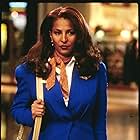
Jackie Brown is the name of a flight attendant who gets caught smuggling her boss' gun money on the airline she works for. Luckily for her, the Fed Ray Nicolet and the LA Cop Mark Dargus decide to team up in order to arrest the arms dealer she works for, whose name they don't even know. Here's when she has to choose one way: tell Nicolet and Dargus about Ordell Robbie (the arms dealer) and get her freedom -except that if Ordell suspects you're talking about him, you're dead- or keep her mouth shut and do some time. That's when she meets Max Cherry -her bail bondsman-, a late fifties, recently separated, burnt-out man, who falls in love with her. Then Jackie comes up with a plan to play the Feds off against Ordell and the guys he works with -Louis Gara and Melanie Ralston, among others- and walk off with their money. But she needs Max's help. No one is going to stand in the way of his million dollar payoff... Written by
Héctor Barca <sandman@arrakis.es>
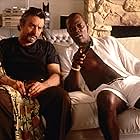
When Robert De Niro first got a hold of the script he wanted to play the role of Max Cherry. Quentin Tarantino wanted to work with De Niro but had his heart set on Robert Forster as Cherry, so he gave the role of Louis to De Niro. See more »
Goofs
The film takes place in 1995. Officer Dargus explains that Jackie was first busted in 1985, then says "Cut to 13 years later...," making 1998 the year in which the film would be occurring. See more »
Quotes
[first lines]
Girl at Security Gate:
Flight 710 to Cabo San Lucas, now boarding Gate 103, first class only. Flight 710, Cabo San Lucas, now boarding Gate 103. First class only.
Jackie Brown:
[greeting passengers]
Buenos dias. Welcome aboard. Welcome aboard.
See more »
Crazy Credits
A copyright notice appears under the title at the beginning of the movie--a common practice for low-budget movies in the 1960s and '70s but very uncommon for 1997. See more »
Where does a director go after making two colossal worldwide hits?
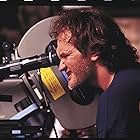
"Reservoir Dogs" (1992) and "Pulp Fiction" (1994) were two of the greatest movies ever made, and they launched director Quentin Tarantino into the realm of Mainstream Hollywood Director. Most of the time, a director faced with this reality will sink into a slew of really bad movies, but so far Tarantino has been either extremely lucky or extremely talented - his third feature film, although lacking in the brutality of its predecessors, contains just as much wit. Based upon the Elmore Leonard novel "Rum Punch," it's packed with the clever dialogue that Leonard is known for in his writing. It's also got a good amount of style, too. It's not a typical Tarantino movie, but is that necessarily a bad thing? In this particular instance, no.
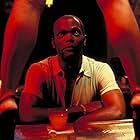
Jackie Brown (Pam Grier) is a flight stewardess forced into running jobs for Ordell (Samuel L. Jackson), a ruthless criminal who has no respect for life - or death, for that matter. However, during one of her smuggling efforts, a couple of FBI Agents (including Michael Keaton) nab her and offer her a deal: If she helps them get Ordell, she will be let free from custody. The Feds do not know who Ordell is, but they know he exists, and that is where Jackie comes in. She reluctantly agrees to participate in their sting operation, but all is not what it seems. And when $500,000 dollars disappears from his retirement fund, Ordell stops, thinks, and arrives upon the conclusion that we all anticipate with glee: Jackie Brown did it.
His partner in crime, Louis (the wonderful Robert De Niro), also decides to double-cross Ordell, with the help of a sexy blonde ditz named Melanie (Bridget Fonda), The movie's twisting plot line and intersecting story lines is very reminiscent of "Pulp Fiction," and De Niro's underrated performance is a real stand-out. The movie's quite well made and enjoyable.
Don't misinterpret what I'm saying. This is no "Reservoir Dogs," nor does it want to be. It's not in the same vein as Tarantino's other movies, at least not at a superficial level. However, it is extremely entertaining, helped along by a great cast and a terrific script. The only difference here is that Tarantino did not come up with everything by himself. He adapted the screenplay from another source, something he usually doesn't do. But there's also a little-known fact that Roger Avary co-wrote some of "Dogs" and "Fiction" with Tarantino, as well as sparked the idea for some of his films. Here, Quentin adapts Leonard's novel and does justice. People who say it isn't as good as his other movies because it's recycled obviously don't know what they're talking about.
Tarantino started out as a video store clerk, and is the movie buff's filmmaker. Not only does Tarantino share a deep passion for films, but he also knows what most of the real movie enthusiasts want. He has yet to disappoint me with any of his directorial efforts. His own life story would make an interesting movie, and indeed it did with "True Romance," partially based on Tarantino's own self-image of himself. (A geek working at a comic book store falls in love and goes off of an adventure into a new realm -- in Tarantino's own case, it was film-making. For Clarence, from "True Romance," it was drugs and murder.)
Tarantino has a flair for raw energy in all of his films, and "Jackie Brown" is no exception. The movie is bursting at its edges, packed with wild antics and the occasional fierce brutality. The movie was criticized by Tarantino's die-hard fans for being too different from his other films. However, the mistake of many directors is to repeat the same formulas over and over again. One must at least give Tarantino credit for trying new things in each of his films. If anything, the only thing that Tarantino likes to insert into all his films is a large source of energy. And is that a bad thing?
4.5/5 stars.
92 of 113 people found this review helpful.
Was this review helpful to you?
Where does a director go after making two colossal worldwide hits?
"Reservoir Dogs" (1992) and "Pulp Fiction" (1994) were two of the greatest movies ever made, and they launched director Quentin Tarantino into the realm of Mainstream Hollywood Director. Most of the time, a director faced with this reality will sink into a slew of really bad movies, but so far Tarantino has been either extremely lucky or extremely talented - his third feature film, although lacking in the brutality of its predecessors, contains just as much wit. Based upon the Elmore Leonard novel "Rum Punch," it's packed with the clever dialogue that Leonard is known for in his writing. It's also got a good amount of style, too. It's not a typical Tarantino movie, but is that necessarily a bad thing? In this particular instance, no.
Jackie Brown (Pam Grier) is a flight stewardess forced into running jobs for Ordell (Samuel L. Jackson), a ruthless criminal who has no respect for life - or death, for that matter. However, during one of her smuggling efforts, a couple of FBI Agents (including Michael Keaton) nab her and offer her a deal: If she helps them get Ordell, she will be let free from custody. The Feds do not know who Ordell is, but they know he exists, and that is where Jackie comes in. She reluctantly agrees to participate in their sting operation, but all is not what it seems. And when $500,000 dollars disappears from his retirement fund, Ordell stops, thinks, and arrives upon the conclusion that we all anticipate with glee: Jackie Brown did it.
His partner in crime, Louis (the wonderful Robert De Niro), also decides to double-cross Ordell, with the help of a sexy blonde ditz named Melanie (Bridget Fonda), The movie's twisting plot line and intersecting story lines is very reminiscent of "Pulp Fiction," and De Niro's underrated performance is a real stand-out. The movie's quite well made and enjoyable.
Don't misinterpret what I'm saying. This is no "Reservoir Dogs," nor does it want to be. It's not in the same vein as Tarantino's other movies, at least not at a superficial level. However, it is extremely entertaining, helped along by a great cast and a terrific script. The only difference here is that Tarantino did not come up with everything by himself. He adapted the screenplay from another source, something he usually doesn't do. But there's also a little-known fact that Roger Avary co-wrote some of "Dogs" and "Fiction" with Tarantino, as well as sparked the idea for some of his films. Here, Quentin adapts Leonard's novel and does justice. People who say it isn't as good as his other movies because it's recycled obviously don't know what they're talking about.
Tarantino started out as a video store clerk, and is the movie buff's filmmaker. Not only does Tarantino share a deep passion for films, but he also knows what most of the real movie enthusiasts want. He has yet to disappoint me with any of his directorial efforts. His own life story would make an interesting movie, and indeed it did with "True Romance," partially based on Tarantino's own self-image of himself. (A geek working at a comic book store falls in love and goes off of an adventure into a new realm -- in Tarantino's own case, it was film-making. For Clarence, from "True Romance," it was drugs and murder.)
Tarantino has a flair for raw energy in all of his films, and "Jackie Brown" is no exception. The movie is bursting at its edges, packed with wild antics and the occasional fierce brutality. The movie was criticized by Tarantino's die-hard fans for being too different from his other films. However, the mistake of many directors is to repeat the same formulas over and over again. One must at least give Tarantino credit for trying new things in each of his films. If anything, the only thing that Tarantino likes to insert into all his films is a large source of energy. And is that a bad thing?
4.5/5 stars.