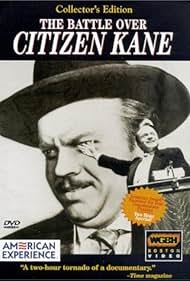
The American Experience: Season 8, Episode 7

The Battle Over Citizen Kane (29 Jan. 1996)

TV Episode  -   -  Documentary | History
7.8
Your rating:
    1 2 3 4 5 6 7 8 9 10 -/10 X  
Ratings: 7.8/10 from 880 users  
Reviews: 13 user | 4 critic

Documentary about the battle between Orson Welles and William Randolph Hearst over Welles' Citizen Kane. Features interviews with Welles' and Hearst's co-workers also as a relative complete bio of Hearst.

0Check in
0Share...

User Lists

Related lists from IMDb users

a list of 41 titles created 18 Apr 2011
 
a list of 151 titles created 1 week ago
 
a list of 326 titles created 4 months ago
 
a list of 607 titles created 11 months ago
 
a list of 888 titles created 18 Jan 2012
 

Connect with IMDb


Share this Rating

Title: The Battle Over Citizen Kane (29 Jan 1996)

The Battle Over Citizen Kane (29 Jan 1996) on IMDb 7.8/10

Want to share IMDb's rating on your own site? Use the HTML below.

Take The Quiz!

Test your knowledge of The American Experience.
« Previous Episode | 94 of  303 Episodes | Next Episode »

Photos

Edit

Cast

Episode credited cast:
William Alland ...
Himself
Thomas Anderson ...
Himself
Richard Ben Cramer ...
Narrator (voice)
...
Himself
Jimmy Breslin ...
Himself
...
Herself (archive footage)
Leonard de Paur ...
Himself
...
Himself
Richard France ...
Himself
William Randolph Hearst ...
Himself (archive footage)
William Herz ...
Himself
Sam Leve ...
Himself
...
Himself
Nancy Loe ...
Herself
Frank Mankiewicz ...
Himself
Edit

Storyline

This documentary, produced for PBS' _"American Experience, The" (1988)_ series, chronicles the struggles between filmmaker Orson Welles and newspaper tycoon William Randolph Hearst over the making and release of Citizen Kane, whose protagonist (Charles Foster Kane) was allegedly a barely fictionalized Hearst. Interviews with contemporaries of Hearst and Welles reveal the intense campaign to suppress the film and ultimately ruin the career of its director. Written by Jesse Garon <grifter@primenet.com>

Plot Summary | Add Synopsis


Edit

Details

Country:

Language:

Release Date:

29 January 1996 (USA)  »

Company Credits

Production Co:

 »
Show detailed on  »

Technical Specs

Runtime:

Sound Mix:

Aspect Ratio:

1.85 : 1
See  »
Edit

Did You Know?

Connections

Edited from The Patsy (1928) See more »

Frequently Asked Questions

This FAQ is empty. Add the first question.

User Reviews

No substitute for watching the movie.
9 August 1999 | by (Dublin, Ireland) – See all my reviews

The conflict between William Randolph Hearst, the press magnate, and Orson Welles, the greatest filmmaker of all time, over the latter's supposedly Hearst-bashing Citizen Kane is a relatively fascinating story (in the sense that real life is rarely as interesting as art), but there is very little new about it in this documentary.

American arts documentaries are generally inferior to British ones, favouring simplistic generalisations over thoughtful analysis. This film consists of footage and interviews that have mostly been seen before, and offers trite comparisons between Hearst's and Welles' life stories to give their clash a false sense of inevitablity and fatedness, when, as with everything, Welles used the bare bones of Hearst's life (it was Herman Mankiewicz's idea to satirise it in the first place) to film his own tragedy.

If you don't know the story, then this is, I suppose, as good a place as any to start. We get biographical sketches of Hearst and Welles, paralells between their notorious careers, and then the facts of the film's creation and reception. Although you can get all this in any popular encyclopaedia, there is much cherishable footage - e.g. Welles' voodoo Macbeth, the celebrity home movies of San Simeon, Welles' silly beard on arriving in Hollywood - and some splendid eye-witness accounts from William Alland (Thompson in Kane), Ruth Warwick (Mrs. Kane) and Norman Lloyd (a Mercury actor).

The range of interviewees in general, though, is very weak, generally plumping for the obvious (Wise, Bogdanovitch), neglecting contributions from Welles scholars, who might have added some complexity or artistic context to the story. There is little analysis of Kane itself within this biographical context - for this you must turn to David Thomson's exemplary, personality-charged biography, Rosebud.

The film also neglects to ask why, if Kane is such a hack-job on Hearst, why is Charles Foster Kane, monstrous flaws and all, such a rich, sympathetic, frequently awe-inspiring, tragic character, while his model was a despicable, mean-minded fascist? The film's only real insight - that Hearst's sole claim to posterity is his connection with Kane - has been proffered before.

Anyone still intrigued by this story after the film, but looking for something meatier, should check out both the Thomson book, and Welles' extraordinary 1982 BBC interview, several moving chunks of which are interspersed here.


7 of 10 people found this review helpful.  Was this review helpful to you?

Message Boards

Recent Posts
This years intro... ag-wktn
When will we see a film about that remarkable hero, Ida B Wells? mazama8290
When are they going to make a movie on this? bette1981
The Satellite Sky craviola880
AMERICAN EXPERIENCE - THE QUIZ SHOW SCANDAL rob1961
Dazzled by 'Amish' Photography rickumali
Discuss The Battle Over Citizen Kane (1996) on the IMDb message boards »

Contribute to This Page

Create a character page for:
?