It's sort of embarrassing to admit it took me ten years to see this film. I'm not really a big fan of Tim Burton, and while I never had anything against him, I've only recently started to enjoy Johnny Depp's work. Given the subject matter, this just wasn't a movie I was interested in for a long time. But sometimes good things really are worth the wait.
Ed Wood, of course, chronicles the Hollywood career of its eponymous subject, truly one screwed up individual; a cross-dresser with a fetish for angora, Wood churned out one horrifically bad film after another, culminating with Plan Nine From Outer Space, before descending into crappy porn films toward the end of his life. It isn't necessarily a happy story, and Burton wisely only tells a small sliver of it, from Ed's first movie, Glen or Glenda, through the premiere of Plan Nine.
But the love that Burton has for Wood and his movies shines through in every frame. Though I find Burton needlessly artsy as a director, here that tendency serves him frightfully well, as he manages to do the near-impossible; make a film about someone that plays like one of their films (the abysmal Dragon is a shining example of how NOT to do this). Shot entirely in black and white, we see all of Wood's weirdos not as they were, but rather as Ed probably saw them, through the bizarre filter he must have viewed life with.
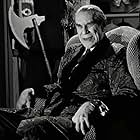
Depp is simply brilliant here, probably even better than he was in Pirates of the Caribbean. He captures Wood's enthusiasm and slanted viewpoint, but he does so in a loving, positive way. Wood accepts, as we must, that he was a screwed-up hack, but it never drags him down; in fact, Depp has him reveling in it, and it is that very passion that buoys up the movie. It doesn't hurt that nearly everyone else is very strong too, from Jeffrey Jones' crank 'psychic' Criswell to Bill Murray's Bunny Breckenridge, who often talks about having a sex change but never goes through with it. George 'The Animal' Steele captures Tor Johnson perfectly, and even Lisa Marie is excellent as Vampira. But the true great performance of the film, outshining even Depp, is Martin Landau as Bela Lugosi. He won the Oscar for this, and deservedly so; he presents Lugosi at the end of his life, a washed-up has been, a shell of a man who was once a great star but is now no more than an addict. Landau virtually disappears in the role, and all you get is Lugosi, every tragic inch of him. Again, we see him not only as he was, but how Wood and even Burton see him, and the effect is masterful. One speech in particular, where Lugosi repeats a speech that Wood wrote for him about once being the master of the world but now on the verge of coming back is particularly haunting, and Landau is simply riveting.
Ed Wood is a rare beast it's a Tim Burton film that doesn't go overboard, it's a movie about Hollywood (sort of) that isn't self-indulgent, it's a nostalgia trip that manages not to be sappy but is still very warm and caring, and overall it's just a strikingly well-done film. I was impressed on many levels, most particularly with Depp and Landau, but really with the whole movie, that such a truly screwed-up human being could be shown in such a positive, indeed, loving way. Ed Wood is nothing less than a tribute to its subject, and in that, as in many other ways, it succeeds marvelously. If somehow you've missed this film, as I had until recently, you owe it to yourself to see it. It's simply a wonderful piece of film-making that should not be missed.