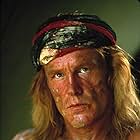
An American soldier who escapes the execution of his comrades by Japanese soldiers in Borneo during WWII becomes the leader of a personal empire among the headhunters in this war story told... See full summary »
Keep track of everything you watch; tell your friends.
If your account is linked with Facebook and you have turned on sharing, this will show up in your activity feed. If not, you can turn on sharing
here
.
An American soldier who escapes the execution of his comrades by Japanese soldiers in Borneo during WWII becomes the leader of a personal empire among the headhunters in this war story told in the style of Joseph Conrad and Rudyard Kipling. The American is reluctant to rejoin the fight against the Japanese on the urging of a British commando team but conducts a war of vengeance when the Japanese attack his adopted people. Written by
Keith Loh <loh@sfu.ca>
The character of Capt. Fairbourne is loosely based on Maj. Tom Harrisson, commander of Semut 1, Z Force. During WWII, Harrisson parachuted into north Borneo and organized the hill tribes to resist the Japanese occupation troops. See more »
Goofs
According to Learoyd's story, roughly three years have passed since he arrived among the tribe, but when he introduces his daughter to Sgt. Corbett, she is clearly five or six years old. See more »
Quotes
[first lines]
Title Card:
THE COAST OF BORNEO - April 1942 / Shortly after the fall of the Philippines the Japanese are triumphant in the Pacific
See more »
This is one of the best films of the 80's yet it is criminally overlooked. Released in an era when Rambo was king, it seems many people just didn't get the film's messages of loyalty, redemption and personal integrity. In other words, it is a true adventure and not just a bang-bang action flick. The kind of movie we need to see more of. Nick Nolte has never been one of my favorite actors but he shines as the gruff King Learoyd. Learoyd is a man of action on the surface but he has been running from conflict his whole life. When he sees that the justice of our "real world" is perverted beyond hope, he retreats to the more honorable world of primitive, uncorrupted Borneo.Eventually, the real world intrudes in the form of World War 2. As The Botanist tells him, "you can no longer avoid history". Learoyd replies, "The world's so full of crap that you're bound to step in it someday. Is that what you call history?" Finally, Learoyd can no longer hide and the war hits him with its full fury. He is shattered by loss yet not unbeaten.He retains his integrity and transcends to non-violence. In one of the film's most emotional scenes, he accepts the surrender of the Japanese Colonel who has tormented him with grace and understanding, leading to the Colonel's own redemption. This is a gorgeous film. full of breathtaking scenery and well-conceived action. The performances are all top-notch, especially Nigel Havers as The Botanist. Why is Havers seen so little?He seems to be an actor of depth and talent. I also enjoyed the character of Tenga, who brought some welcome humor to the movie. Farewell to the King can be accused of being too sentimental and I can't disagree. There are worse things to have in a movie than sentiment, though. I hope this film achieves some of the recognition it is due. It is certainly John Milius' best.
10 of 14 people found this review helpful.
Was this review helpful to you?
This is one of the best films of the 80's yet it is criminally overlooked. Released in an era when Rambo was king, it seems many people just didn't get the film's messages of loyalty, redemption and personal integrity. In other words, it is a true adventure and not just a bang-bang action flick. The kind of movie we need to see more of. Nick Nolte has never been one of my favorite actors but he shines as the gruff King Learoyd. Learoyd is a man of action on the surface but he has been running from conflict his whole life. When he sees that the justice of our "real world" is perverted beyond hope, he retreats to the more honorable world of primitive, uncorrupted Borneo.Eventually, the real world intrudes in the form of World War 2. As The Botanist tells him, "you can no longer avoid history". Learoyd replies, "The world's so full of crap that you're bound to step in it someday. Is that what you call history?" Finally, Learoyd can no longer hide and the war hits him with its full fury. He is shattered by loss yet not unbeaten.He retains his integrity and transcends to non-violence. In one of the film's most emotional scenes, he accepts the surrender of the Japanese Colonel who has tormented him with grace and understanding, leading to the Colonel's own redemption. This is a gorgeous film. full of breathtaking scenery and well-conceived action. The performances are all top-notch, especially Nigel Havers as The Botanist. Why is Havers seen so little?He seems to be an actor of depth and talent. I also enjoyed the character of Tenga, who brought some welcome humor to the movie. Farewell to the King can be accused of being too sentimental and I can't disagree. There are worse things to have in a movie than sentiment, though. I hope this film achieves some of the recognition it is due. It is certainly John Milius' best.