Keep track of everything you watch; tell your friends.
If your account is linked with Facebook and you have turned on sharing, this will show up in your activity feed. If not, you can turn on sharing
here
.
When a man with AIDS is fired by a conservative law firm because of his condition, he hires a homophobic small time lawyer as the only willing advocate for a wrongful dismissal suit.
Director:
Jonathan Demme
Stars:
Tom Hanks,
Denzel Washington,
Roberta Maxwell
An aspiring author during the civil rights movement of the 1960s decides to write a book detailing the African-American maids' point of view on the white families for which they work, and the hardships they go through on a daily basis.
Director:
Tate Taylor
Stars:
Emma Stone,
Viola Davis,
Bryce Dallas Howard
Disgruntled Korean War vet Walt Kowalski sets out to reform his neighbor, a young Hmong teenager, who tried to steal Kowalski's prized possession: his 1972 Gran Torino.
Director:
Clint Eastwood
Stars:
Clint Eastwood,
Christopher Carley,
Bee Vang
Oakland A's general manager Billy Beane's successful attempt to assemble a baseball team on a lean budget by employing computer-generated analysis to acquire new players.
Director:
Bennett Miller
Stars:
Brad Pitt,
Jonah Hill,
Philip Seymour Hoffman
Upon admittance to a mental institution, a brash rebel rallies the patients to take on the oppressive head nurse, a woman he views as more dictator than nurse.
Director:
Milos Forman
Stars:
Michael Berryman,
Peter Brocco,
Louise Fletcher
Painfully shy Todd Anderson has been sent to the school where his popular older brother was valedictorian. His room-mate, Neil, although exceedingly bright and popular, is very much under the thumb of his overbearing father. The two, along with their other friends, meet Professor Keating, their new English teacher, who tells them of the Dead Poets Society, and encourages them to go against the status quo. Each, in their own way, does this, and are changed for life. Written by
Liz Jordan <c9310494@alinga.newcastle.edu.au>
The part of John Keating was once intended for Dustin Hoffman. The film was also going to be Hoffman's directorial debut before Hoffman withdrew from the film. See more »
Goofs
The first meeting of the Dead Poets Society in the cave is at night but there is light through the hole in the ceiling. See more »
Quotes
John Keating:
I SOUND MY BARBARIC YAWP OVER THE ROOFTOPS OF THE WORLD.
See more »
Dead Poets Society is, to use a cliché, a cinematic masterpiece. I can watch it over and over, absorbing more nuances of meaning every time. As a former teacher myself (albeit of science), I view it as a tribute to the profession at its best...teaching not merely the subject but also the person, and having a lifelong impact on students' lives.
The setting is Weldon Academy, a very traditional New England boys' prep school in 1959. If I can find one flaw with the movie...and there certainly aren't many...it's the underlying premise that seems to worship free thought and implies that ALL tradition is of necessity undesirable and thus to be avoided. Frankly, compared to modern classrooms which are bastions of free expression, I found the Weldon students' respectful treatment of their teachers rather refreshing. (But perhaps that's just the ex-teacher in me coming out!) Some of Weldon's ideals, generally referred to in mocking tones, are actually qualities to which parents rightfully DO hope their offspring will aspire.
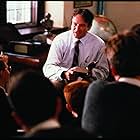
Robin Williams plays Mr. Keating, the English teacher we all wish we'd had. He brings warmth, passion, and an endearing quiet humor to the role as he fosters individualism in a school environment of total conformity, endeavoring to teach these young men both the beauty of the English language and the importance of living life to the full, of "seizing the day". How many of us mentally revolted at the dissection of poetry when we were in school? Many a viewer will both chortle and rejoice when Mr. Keating has his class rip out the methodical, emotionless "Introduction to Poetry" from the time honored Pritchard textbook!
The "Dead Poets Society", and the boys on which Mr. Keating has such a profound impact, include an interesting mix of characters...Neil Perry (the passionate young man at odds with his father's clearly defined expectations for his son's life), Todd Anderson (the classic shy adolescent, through whose eyes we view the unfolding drama), Charlie Dalton (the quintessential rebel), Knox Overstreet (the teen with whom most viewers can identify, deep in the throes of first love), and Richard Cameron (the mindless conformist).
Ethan Hawke gives a moving performance as Todd, the younger brother of a former Weldon valedictorian and my personal favorite, who undergoes a character transformation as the plot unfolds. In a sense, this movie is really Todd's story. As another reviewer has wisely pointed out, his best scenes are sometimes when he has no dialogue at all. Your heart will ache for him. The sub-plot of young Overstreet's romance with a girl from a nearby school may not be brilliant, but it provides some light, entertaining relief from the main drama.
Needless to say, Mr. Keating's unorthodox approach meets with obstacles...from his fellow teachers, from the school's ultra traditional Headmaster, from Neil's overbearing father and the other parents, who are depicted as a conservative, status conscious lot. His encouragement of adolescent individualism leads to dramatic consequences for one student in particular, triggering a dramatic scenario that engulfs most of his classmates. I don't want to give the plot away, but Dead Poets Society has the most powerful ending I've experienced in the cinematic world. I could watch it over and over, and tears would either come to my eyes or virtually stream down my cheeks every time.
It's an intelligent film, both gripping to watch and thought provoking afterward. Engaging plot, memorable characters, meaningful theme, wonderfully done scenes and atmosphere...Dead Poets Society has it all. A special tip of my hat to the cinematography; clearly, it should have won an Oscar for the final scene alone.
This is a must-see movie, especially if you're a high school student who hates English. It might just change your view of the subject, even if your actual teacher doesn't quite measure up to Mr. Keating. And for everyone...not only "Carpe Diem", but a certain phrase from a Walt Whitman poem will take on incredible meaning and be remembered forever.
75 of 92 people found this review helpful.
Was this review helpful to you?
Dead Poets Society is, to use a cliché, a cinematic masterpiece. I can watch it over and over, absorbing more nuances of meaning every time. As a former teacher myself (albeit of science), I view it as a tribute to the profession at its best...teaching not merely the subject but also the person, and having a lifelong impact on students' lives.
The setting is Weldon Academy, a very traditional New England boys' prep school in 1959. If I can find one flaw with the movie...and there certainly aren't many...it's the underlying premise that seems to worship free thought and implies that ALL tradition is of necessity undesirable and thus to be avoided. Frankly, compared to modern classrooms which are bastions of free expression, I found the Weldon students' respectful treatment of their teachers rather refreshing. (But perhaps that's just the ex-teacher in me coming out!) Some of Weldon's ideals, generally referred to in mocking tones, are actually qualities to which parents rightfully DO hope their offspring will aspire.
Robin Williams plays Mr. Keating, the English teacher we all wish we'd had. He brings warmth, passion, and an endearing quiet humor to the role as he fosters individualism in a school environment of total conformity, endeavoring to teach these young men both the beauty of the English language and the importance of living life to the full, of "seizing the day". How many of us mentally revolted at the dissection of poetry when we were in school? Many a viewer will both chortle and rejoice when Mr. Keating has his class rip out the methodical, emotionless "Introduction to Poetry" from the time honored Pritchard textbook!
The "Dead Poets Society", and the boys on which Mr. Keating has such a profound impact, include an interesting mix of characters...Neil Perry (the passionate young man at odds with his father's clearly defined expectations for his son's life), Todd Anderson (the classic shy adolescent, through whose eyes we view the unfolding drama), Charlie Dalton (the quintessential rebel), Knox Overstreet (the teen with whom most viewers can identify, deep in the throes of first love), and Richard Cameron (the mindless conformist).
Ethan Hawke gives a moving performance as Todd, the younger brother of a former Weldon valedictorian and my personal favorite, who undergoes a character transformation as the plot unfolds. In a sense, this movie is really Todd's story. As another reviewer has wisely pointed out, his best scenes are sometimes when he has no dialogue at all. Your heart will ache for him. The sub-plot of young Overstreet's romance with a girl from a nearby school may not be brilliant, but it provides some light, entertaining relief from the main drama.
Needless to say, Mr. Keating's unorthodox approach meets with obstacles...from his fellow teachers, from the school's ultra traditional Headmaster, from Neil's overbearing father and the other parents, who are depicted as a conservative, status conscious lot. His encouragement of adolescent individualism leads to dramatic consequences for one student in particular, triggering a dramatic scenario that engulfs most of his classmates. I don't want to give the plot away, but Dead Poets Society has the most powerful ending I've experienced in the cinematic world. I could watch it over and over, and tears would either come to my eyes or virtually stream down my cheeks every time.
It's an intelligent film, both gripping to watch and thought provoking afterward. Engaging plot, memorable characters, meaningful theme, wonderfully done scenes and atmosphere...Dead Poets Society has it all. A special tip of my hat to the cinematography; clearly, it should have won an Oscar for the final scene alone.
This is a must-see movie, especially if you're a high school student who hates English. It might just change your view of the subject, even if your actual teacher doesn't quite measure up to Mr. Keating. And for everyone...not only "Carpe Diem", but a certain phrase from a Walt Whitman poem will take on incredible meaning and be remembered forever.