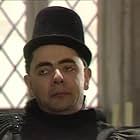
The Black Adder (1983– ) 8.3
In the Middle Ages, Prince Edmund the Black Adder constantly schemes and endeavors to seize the crown from his father and brother. |
|
| 0Share... |
The Black Adder (1983– ) 8.3
In the Middle Ages, Prince Edmund the Black Adder constantly schemes and endeavors to seize the crown from his father and brother. |
|
| 0Share... |
| Series cast summary: | |||
| Rowan Atkinson | ... |
Edmund, Duke of Edinburgh
(7 episodes, 1982-1983)
|
|
| Elspet Gray | ... |
The Queen
(7 episodes, 1982-1983)
|
|
| Tim McInnerny | ... |
Percy
(7 episodes, 1982-1983)
|
|
|
|
Robert East | ... |
Harry, Prince of Wales
(6 episodes, 1983)
|
| Brian Blessed | ... |
King Richard IV
(6 episodes, 1983)
|
|
| Tony Robinson | ... |
Baldrick
(6 episodes, 1983)
|
|
|
|
Bert Parnaby | ... |
Cain, A Blind Beggar
(3 episodes, 1983)
|
|
|
Roy Evans | ... |
Abel, A Blind Beggar
(3 episodes, 1983)
|
|
|
David Nunn | ... |
Messenger
(3 episodes, 1983)
|
Set in England at the end of the War of the Roses, we soon find out that the history we know is a Tudor fiction. In fact, Henry VII did not actually win the battle of Bosworth Field; he lost and though Richard III died in the battle, his nephew King Richard IV (who certainly was not smothered while still a boy in the Tower of London) reigned on for some years. The story focuses on Richard IV's younger son Prince Edmund, a sniveling coward who calls himself the 'Black Adder'. Assisted by his grungy servant Baldrick and the moronic Lord Percy, Edmund plots his rise to greatness. Written by Reid Gagle
This is the first, and in my opinion, the best of the Blackadder series - although the second installment runs a very close second. This series, in retrospect, is often dismissed as less funny than its successors and this may be due to its different style and sense of humour. This comparison unfortunately causes the viewer to miss what makes this series such an excellent piece of comedy writing and production.
The whole series centres on Edmund (Rowan Atkinson), the son of the younger of the two princes who in history were murdered in the Tower of London, allegedly by Richard III. In this take on history, where real history is dismissed as being rewritten by Henry Tudor, the princes were not murdered and Richard Duke of York grows up 'to be a strong boy'. The first episode of the series lays the foundation, explaining how Richard III dies, how Edmund's father becomes King and also the important, accidental, foretelling by three Witches (a clever alude to the witches in Shakespeare's Macbeth) to Edmund that one day he will be King. The rest of the series follows Edmund in his attempts to realise this foretelling.
Edmund's definite goal throughout the series, which forms the basis of the subsequent plotlines, gives it a direction perhaps missing in the following series, and it also gives his character more depth. Blackadder (as he names himself), in this series, is significantly different to his persona of the subsequent time-periods - being slimy, selfish and not particularly bright. There is a definite bond between the main characters, Blackadder and his sidekicks, Percy and Baldrick (excellently played by Tim McInnerny and Tony Robinson respectively) and although Blackadder treats his underlings with contempt at times, they collaborate as a team throughout in a series of 'cunning plans'. Baldrick is indeed the intelligent character of the group, the man in the know and his character has much more depth than his smelly and stupid character of later series.
Each plot in the series follows a similar pattern - Blackadder getting himself into a situation and having to get himself out of it. The humour presented is more subtle, relying more on the use of visual comedy, language and historical satire than on blind sarcasm. Many of the gags are implied and expect the viewer to work out the meaning as opposed to ramming it down their throats. Additionally, the script contains a number of lines that cleverly misuse Shakespeare for added effect, a classic example being Richard III calling for 'my horse, my horse my kingdom for a horse' in the style of someone calling for his dog. The supporting cast all play their part superbly, particularly Brian Blessed as Richard IV, the maniacal war-monger who hates his slimy son and fails to get his name right. The late, great Peter Cook also makes an appearance as Richard III in the first episode.
This series must be watched out of context with what followed. It was not written for the popular market, being first screened on BBC2. Watch it, laugh, then watch it again to catch some of the gags you missed the first time. Comedy written this well is unfortunately extremely rare, and to dismiss it without appreciating its aims does not do it justice. This series not only shows Rowan Atkinson at his very best, but also the writing of Richard Curtis (and Atkinson) and it is an overlooked classic of British comedy.