

An ex-con drifter with a penchant for brawling is amused by a homeless ex-sailor, so they partner up as they head east together.An ex-con drifter with a penchant for brawling is amused by a homeless ex-sailor, so they partner up as they head east together.An ex-con drifter with a penchant for brawling is amused by a homeless ex-sailor, so they partner up as they head east together.
- Awards
- 4 wins




- Annie
- (as Penny Allen)

- Hooker
- (uncredited)
- Child
- (uncredited)
- Bartender
- (uncredited)
- Hippie
- (uncredited)
- Lion's Son
- (uncredited)
- Myra
- (uncredited)
- Waitress
- (uncredited)
- Young Man
- (uncredited)
- Director
- Writer
- All cast & crew
- Production, box office & more at IMDbPro
Storyline
Did you know
- TriviaGene Hackman has stated that his performance in Scarecrow (1973) is his personal favorite.
- Quotes
Lion: Hey Max, you heard the story of the scarecrow?
Max Millan: No.
Lion: You think crows are scared of a scarecrow?
Max Millan: Yeah, I think they're scared. Yeah why?
Lion: No, crows are not scared, believe me.
Max Millan: The god damn crows are scared.
Lion: No, crows are laughin'.
Max Millan: Nah, that's bullshit...
Lion: That's right, the crows are laughin'. Look, the farmer puts out a scarecrow, right, with a funny hat on it, got a funny face. The crows fly by, they see that, it strikes 'em funny, makes 'em laugh.
Max Millan: The god damn crows are laughin'?
Lion: That's right, they're laughin' their asses off. And then they say, "Well, that ol' farmer Jo down there, he's a pretty good guy. He made us laugh, so he won't bother him any more."
Max Millan: The god damn crows are laughin'...
Lion: Ohh, they laughin', woooo!
Max Millan: I gotta tell ya somethin', that's the most hare-brained idea I've ever heard.
Lion: It's true, they're laughin' their asses off.
Max Millan: The crows are laughin'... I guess the fish are reciting poetry...
Lion: I guess so.
Max Millan: Uh huh... and the uh, pigs are playin' banjo? And the dogs would be, let's see, uh... playin' hockey. And the uh... the uh...
Lion: Crows are laughin'.
Max Millan: Crows are laughin', right. Ya know, in the joint I've heard some tales, oh boy, golly I've heard some tall tales. But at least those guys had the decency to admit that it was bullshit, you know what I mean? They actually took pride, pride in that it was bullshit. But the crows are laughin' huh? I mean you're not playin' with a full deck man, you got one foot in the grave beyond.
- ConnectionsFeatured in A Decade Under the Influence (2003)
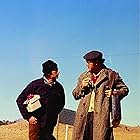
No child and no sailor, but rather an ex-sailor with a child-like personality: this is Al Pacino as Francis Lionel Delbucci aka 'Lion', and no rookie who's going to jail, no streetwise bad-ass, but a robust and short-tempered ex-convict: this is Gene Hackman as Max Millian, forming with Lion one of the most unlikely and endearing pairing of the New Hollywood period. After the gripping documentary-like "The Panic in Needle Park", Jerry Schwartzberg signs another piece of art about two misfit characters, indulging in more poetical and philosophical statements about life, from two vagabonds who meet in a two-lane road penetrating deserted hills, the fitting setting for two men at the crossroads of their lives.
Max wants to go to Pittsburgh where he sent all the money he earned during his jail time, his plan is to open a car wash. And 'Lion' left his girl Annie (Penelope Allen) while she was pregnant. He was so scared he never knew if it was a boy or a girl and never made amend of his irresponsible act except by sending money for five years. Carrying a little lamp in gift-box, he wants to see his child and Annie to forgive him, before starting a new life. The gift-box is the reminder of actions that might contain the roots of his juvenile and optimistic attitude, trying to make people laugh as a way to hide a tormenting guilt. We're inclined to believe this because Max, the one who paid his debt to society, has nothing to blame himself on anymore, and exudes self-confidence and moral strength.
The contrast between Lion and Max is the soul of the movie and the cement of their relationship, almost a 'friendship at first sight' but the real decisive step was when Lion gave his last match to Max, a gesture that made Max develop a genuine fondness and instinctive trust of Lion: he proposes a partnership in the car wash business and Lion's acceptance doesn't say much because he strikes as a character who never says 'no'. As the movie goes on, we know more about his philosophy of life, maybe sometimes in a too explicit way. Lion believes that making people laugh is the best antidote against hostility and aggressiveness, in a nutshell, "scarecrows make crow laugh". Al Pacino conveys the illusion of an optimistic nature that hardly hides a desperate desire to be loved and accepted. 'Lion' incorporates within the same character the cowardly lion of "The Wizard of Oz" because he can't face the hideous side of life and the scarecrow with a heart, a big and generous heart. Al Pacino delivers one of his finest performances, even more impressive because it was made right after a total opposite role, as the charismatic and menacing Michael Corleone, indeed, this 'Lion' is no 'Lionheart'.
Gene Hackman said it was his favorite performance and I can see why. he plays a strong man, a no-nonsense guy who takes no crap from anyone, who's never reluctant to fight if someone disrespects him, and sticks to his plan of car wash no matter what happens. And unlike Lion aka the scarecrow, he has the brains; he's got intelligence and street smarts. He completes Lion's naivety and lack of realism, while Lion, in his way, injects his joyful and cheerful nature in Max. Yet it would be too convenient to take their complementarity for granted. Yes they complete each other but one has more to learn about life. There's no doubt that the picaresque journey the two characters would take, will teach them a few lessons or two but Max only has to loosen up a bit, and to use a sense of humor while Lion, is the one who'll learn the hard way the limits of his theory about scarecrows, after one crucial visit to Max' sister in Denver that would end in another conviction to jail.
Lion is the victim of a rape attempt from an inmate named Riley (Richard Lynch), in a scene even more disturbing because Lion is such an adorable character, he'll try to use humor as a defense, totally blinded by his own naivety, but Riley breaks Lion's shield as if it was made of paper. Max eventually avenges his friend, but after the jail episode, nothing would be the same. There is one crucial moment where Max avoids fighting by starting a striptease, and it's obvious that he pulled some of Lion's character in his attitude. Yet, it's a bittersweet moment, because at the same time, Lion stares at him with melancholy. This look on Pacino's face has been debated countless times, my belief is that he understood how limited he was in this rude life. His happy-go-lucky philosophy only had sense if he could handle tougher situations, a guy like Max can afford to make people laugh because he impresses too. Lion understands that a scarecrow still has to scare crows, otherwise, they eat the seeds.
Roger Ebert compared the film to "Easy Rider" and "Midnight Cowboy" with two men joining their efforts for a a better future, I myself found a deeper and more poignant connection with Fellini's "La Strada" especially through its tragic undertones. I was so upset by the film's conclusion that I hesitated to see it twice. But it's truly an absorbing and penetrating film about two misunderstood souls, one strong enough to deal with life, and another one who well, I can only hope, sincerely hope, for an off-screen happy ending.
- ElMaruecan82
- Oct 16, 2012
- How long is Scarecrow?Powered by Alexa
Details
- Release date
- Country of origin
- Language
- Also known as
- Asphalt-Blüten
- Filming locations
- 539 West 43rd Avenue, Denver, Colorado, USA(Turk's Supper Club)
- Production company
- See more company credits at IMDbPro
Box office
- Gross US & Canada
- $9,000,000
- Runtime1 hour 52 minutes
- Sound mix
- Aspect ratio
- 2.39 : 1
Contribute to this page


