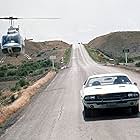
Kowalski works for a car delivery service. He takes delivery of a 1970 Dodge Challenger to take from Colorado to San Francisco, California. Shortly after pickup, he takes a bet to get the ... See full summary »
Keep track of everything you watch; tell your friends.
If your account is linked with Facebook and you have turned on sharing, this will show up in your activity feed. If not, you can turn on sharing
here
.
The youngest son of an alcoholic former boxer returns home, where he's trained by his father for competition in a mixed martial arts tournament - a path that puts the fighter on a collision corner with his older brother.
The story of two men on different sides of a prison riot -- the inmate leading the rebellion and the young guard trapped in the revolt, who poses as a prisoner in a desperate attempt to survive the ordeal.
Director:
Daniel Monzón
Stars:
Luis Tosar,
Alberto Ammann,
Antonio Resines
In the depression, Chaney, a strong silent streetfighter, joins with Speed, a promoter of no-holds-barred street boxing bouts. They go to New Orleans where Speed borrows money to set up ... See full summary »
Director:
Walter Hill
Stars:
Charles Bronson,
James Coburn,
Jill Ireland
Activists arrive in Seattle, Washington en masse to protest a meeting of the World Trade Organization. Riots and chaos ensue as demonstrators successfully stop the WTO meetings.
In the second film of the Lone Wolf and Cub series, Ogami Itto battles a group of female ninja in the employ of the Yagyu clan and must assassinate a traitor who plans to sell his clan's ... See full summary »
A chilling vision of the House of Saddam Hussein comes to life through the eyes of the man who was forced to become the double of Hussein's sadistic son.
The archetypical renegade Texas Ranger wages war against a drug kingpin with automatic weapons, his wits and martial arts after a gun battle leaves his partner dead. All of this inevitably ... See full summary »
Director:
Steve Carver
Stars:
Chuck Norris,
David Carradine,
Barbara Carrera
Kowalski works for a car delivery service. He takes delivery of a 1970 Dodge Challenger to take from Colorado to San Francisco, California. Shortly after pickup, he takes a bet to get the car there in less than 15 hours. After a few run-ins with motorcycle cops and highway patrol they start a chase to bring him into custody. Along the way, Kowalski is guided by Supersoul - a blind DJ with a police radio scanner. Throw in lots of chase scenes, gay hitchhikers, a naked woman riding a motorbike, lots of Mopar and you've got a great cult hit from the early 70's. Written by
Matthew
At 21:49, after Super Soul receives the first radio report about Kowalski, the Challenger goes up a hill into shadow with a large mound of earth on the left side of the road, then the road curves right at the top of the hill. A few seconds later, after a cut showing Kowalski driving, the car is on the road down the hill before the shadow, ready to climb the same hill again. See more »
Richard Sarafian's 1971 film "Vanishing Point" is, for starters, a fascinating study of those persons anthropologists sometimes term "marginal men"--individuals caught between two powerful and competing cultures, sharing some important aspects of both but not a true part of either, and, as such, remain tragically confined to an often-painful existential loneliness. Inhabiting a sort of twilight zone between "here" and "there," a sort of peculiar purgatory, these restless specters cannot find any peace or place, so they instead instinctively press madly on to some obscure and unknown destination, the relentless journey itself being the only reason and justification.
Disc jockey Super Soul (Cleavon Little) and delivery driver Kowalski (Barry Newman) are two of these specters, marginal but decent, intelligent men who can't or won't live in burgeoning competing cultures which in reality have offered them very little of worth or substance, despite their own personal sacrifices. Kowalski himself had tried to "fit in" with the Establishment as a soldier and police officer and later, attempted to do the same with the blossoming 1960s counterculture, but soon disappointingly found that they both were ridden with their own various forms of dishonesty and insincerity. Personal honor, self-reliance and genuine respect--Kowalski's stock in trade--were tragically valued very little by either, despite each one's shrill and haughty claims to the contrary.
Moreover, it's no accident Newman's character has a Polish surname; the Poles throughout their history have created a very rich and unique Slavic culture largely based upon just such a "marginality"--being geographically jammed between powerful historic enemies, Germany and Russia, and never being able to fully identify with either one, at often great cost to themselves. It's also no accident Little's character is blind and black, the only one of his kind in a small, all-Caucasian western desert town--his sightlessness enhancing his persuasiveness and his ability to read Kowalski's mind, the radio microphone his voice, his race being the focus of long simmering and later suddenly explosive disdain--all of the characteristics of a far-seeing prophet unjustly (but typically) dishonored in his own land.
The desert environment also plays a key role in cementing the personal relationship between and respective fates of these two men--to paraphrase British novelist J.G. Ballard, prophets throughout our history have emerged from deserts of some sort since deserts have, in a sense, exhausted their own futures (like Kowalski himself had already done) and thus are free of the concepts of time and existence as we have conventionally known them (as Super Soul instinctively knew, thus creating his own psychic link to the doomed driver.) Everything is somehow possible, and yet, somehow nothing is.
Finally, VP is also a "fin de siecle" story, a unique requiem for a quickly dying age- a now all-but-disappeared one of truly open roads, endless speed for the joy of speed's sake, of big, solid no-nonsense muscle cars, of taking radical chances, of living on the edge in a colorful world of endless possibility, seasoned with a large number and wide variety of all sorts of unusual characters, all of which had long made the USA a wonderful place--and sadly is no longer, having been supplanted by today's swarms of sadistic, military-weaponed cop-thugs, obsessive and intrusive safety freaks, soulless toll plazas, smug yuppie SUV drivers, tedious carbon-copy latte towns, and a childish craving for perfect, high-fuel-efficiency safety and security.
The just-issued DVD contains both the US and UK releases of the film; the UK release, I believe, is a much more satisfying film, as it has the original scenes deleted from the US version. As an aside, Super Soul's radio station call letters, KOW, are in fact the ones for a country & western station in San Diego.
178 of 203 people found this review helpful.
Was this review helpful to you?
Richard Sarafian's 1971 film "Vanishing Point" is, for starters, a fascinating study of those persons anthropologists sometimes term "marginal men"--individuals caught between two powerful and competing cultures, sharing some important aspects of both but not a true part of either, and, as such, remain tragically confined to an often-painful existential loneliness. Inhabiting a sort of twilight zone between "here" and "there," a sort of peculiar purgatory, these restless specters cannot find any peace or place, so they instead instinctively press madly on to some obscure and unknown destination, the relentless journey itself being the only reason and justification.
Disc jockey Super Soul (Cleavon Little) and delivery driver Kowalski (Barry Newman) are two of these specters, marginal but decent, intelligent men who can't or won't live in burgeoning competing cultures which in reality have offered them very little of worth or substance, despite their own personal sacrifices. Kowalski himself had tried to "fit in" with the Establishment as a soldier and police officer and later, attempted to do the same with the blossoming 1960s counterculture, but soon disappointingly found that they both were ridden with their own various forms of dishonesty and insincerity. Personal honor, self-reliance and genuine respect--Kowalski's stock in trade--were tragically valued very little by either, despite each one's shrill and haughty claims to the contrary.
Moreover, it's no accident Newman's character has a Polish surname; the Poles throughout their history have created a very rich and unique Slavic culture largely based upon just such a "marginality"--being geographically jammed between powerful historic enemies, Germany and Russia, and never being able to fully identify with either one, at often great cost to themselves. It's also no accident Little's character is blind and black, the only one of his kind in a small, all-Caucasian western desert town--his sightlessness enhancing his persuasiveness and his ability to read Kowalski's mind, the radio microphone his voice, his race being the focus of long simmering and later suddenly explosive disdain--all of the characteristics of a far-seeing prophet unjustly (but typically) dishonored in his own land.
The desert environment also plays a key role in cementing the personal relationship between and respective fates of these two men--to paraphrase British novelist J.G. Ballard, prophets throughout our history have emerged from deserts of some sort since deserts have, in a sense, exhausted their own futures (like Kowalski himself had already done) and thus are free of the concepts of time and existence as we have conventionally known them (as Super Soul instinctively knew, thus creating his own psychic link to the doomed driver.) Everything is somehow possible, and yet, somehow nothing is.
Finally, VP is also a "fin de siecle" story, a unique requiem for a quickly dying age- a now all-but-disappeared one of truly open roads, endless speed for the joy of speed's sake, of big, solid no-nonsense muscle cars, of taking radical chances, of living on the edge in a colorful world of endless possibility, seasoned with a large number and wide variety of all sorts of unusual characters, all of which had long made the USA a wonderful place--and sadly is no longer, having been supplanted by today's swarms of sadistic, military-weaponed cop-thugs, obsessive and intrusive safety freaks, soulless toll plazas, smug yuppie SUV drivers, tedious carbon-copy latte towns, and a childish craving for perfect, high-fuel-efficiency safety and security.
The just-issued DVD contains both the US and UK releases of the film; the UK release, I believe, is a much more satisfying film, as it has the original scenes deleted from the US version. As an aside, Super Soul's radio station call letters, KOW, are in fact the ones for a country & western station in San Diego.