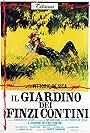
The Garden of the Finzi-Continis
(1970)
|
|
| Watch Trailer 0Share... |
The Garden of the Finzi-Continis
(1970)
|
|
| Watch Trailer 0Share... |
| Cast overview, first billed only: | |||
|
|
Lino Capolicchio | ... |
Giorgio
|
| Dominique Sanda | ... |
Micòl Finzi Contini
|
|
| Fabio Testi | ... |
Bruno Malnate
|
|
|
|
Romolo Valli | ... |
Giorgio's Father
|
| Helmut Berger | ... |
Alberto
|
|
|
|
Camillo Cesarei | ... |
Micol's Father
|
|
|
Inna Alexeievna | ... |
Micol's Grandmother
(as Inna Alexeieff)
|
|
|
Katina Morisani | ... |
Micol's Mother
|
| Barbara Pilavin | ... |
Giorgio's Mother
(as Barbara Leonard Pilavin)
|
|
|
|
Michael Berger |
|
|
|
|
Ettore Geri |
|
|
|
|
Raffaele Curi | ... |
Ernesto
|
|
|
Gianpaolo Duregon |
|
|
|
|
Marcella Gentile |
|
|
|
|
Cinzia Bruno | ... |
Young Micol
|
In the late 1930s, in Ferrara, Italy, the Finzi-Contini are one of the leading families, wealthy, aristocratic, urbane; they are also Jewish. Their adult children, Micol and Alberto, gather a circle of friends for constant rounds of tennis and parties at their villa with its lovely grounds, keeping the rest of the world at bay. Into the circle steps Giorgio, a Jew from the middle class who falls in love with Micol. She seems to toy with him, and even makes love to one of his friends while she knows Giorgio is watching. While his love cannot seem to break through to her to draw her out of her garden idyll, the forces of politics close in. Written by <jhailey@hotmail.com>
De Sica is celebrated as the man who brought "neo-realism" to film, one of the three or four philosophies that still vie as motivation for the film enterprise. It is the notion that though film necessarily artificializes, it is possible to start with truth and deliberately enhance it cinematic ally. Because he relied on class struggle, viewers mistakenly associate that with the essence of neo-realism.
His early work is much celebrated, but as he aged and added layers and nuance, his relatively simpleminded audience was lost. Here we have a later masterpiece, not generally regarded as such.
The basic story is of two Jewish families, the impeding brutality of fellow Italians and different approaches to life and love in the knowing face of doom. At that level, it has some charm and power.
But what he has done is to invert all the values and superimpose them on the originals. Its a common technique in writing, and found of course in the novel.
We have the obvious: a relatively small garden within which the inhabitants blithely create an artificial world while the real world grinds down upon them. The garden is in Europe, but it is also Europe.
As I say, That's obvious. Also common (far too common) is the placement of sexual mechanics in political mechanics as if one explains the other while they cause each other. Ho Hum.
But there are three other elements, and these I appreciate. While he is reversing things and overlaying them, he casts accordingly. The European fiction was that Jews were dark, earthy people. Hairy, monetary, shrewd, animal. Yet the actors who play the Jews are according to cinematic conventions of Aryans: light haired, light skinned, svelte. Their manner is similarly cinematic (and the Nazi/fascist movement was inherently cinematic): completely unconcerned about money and politics and instead concerned about poetry and idleness. Roles reversed: we know this for certain when the (Jewish) girl tells her (non-Jewish) suitor he is not her type; too communist and too hairy.
There's another, explicit inversion: the thing is a movie, but the anchor of reality within it is, well, movies. Three times. Plus our hero goes from Passover at his house where the family is singing something vapid to the Finzi-Continis where they are doing something movie-like" looking into a glass to see the future.
Third: we know this is not straight-on narrative, because the camera has a habit of drifting out of the narrative frame. Kar-Wai is the current master of this and for the same reason.
Naturally, underlying it all is that this is not the work of fascists or Nazis, but of Italians and Germans. Not few, but many, essentially all. Because of that one thing, I find this more powerful than "Schindler's List." Sure, his people were more demonstrably evil, but so are all his villains in his fakey worlds. It doesn't make it real if he shows real history in the same theatrical way. No, for real evil we have to see how ordinary it is.
Ted's Evaluation -- 3 of 3: Worth watching.