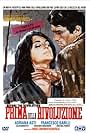
One of the typical ploys of modernist artists has been to take a known work, and to use that as a basis for experimentation. In this case, Bernardo Bertolucci (at the age of 22!) took Stendhal's novel THE CHARTERHOUSE OF PARMA and used the basic plot and characters, only Bertolucci abstracted these elements, taking them for granted and simply creating a wide-ranging collage of impressions and emotions. But the central love affair between Fabrizio and his aunt, Gina (the names of the characters in the Stendhal), is the motivating heart of the film; the suggestions of incest, the need for secrecy, the impacted emotion because of the covertness: these provide PRIMA DELLA RIVOLUZIONE with a core of great integrity, so that the more "random" elements (the scene with the lament on the lake, the scene at the opera, the scene where the friend rides the bicycle in circles, etc.) are able to reflect on Bertolucci's feelings regarding politics, class, revolution, art, the search for belief.
PRIMA DELLA RIVOLUZIONE is one of the most youthful films ever made, as well it should be, since it was made by someone who was impossibly young at the time. I hate to say this, but it's the work of a prodigy, a gifted post-adolescent who is trying to find a form to contain his sometimes overwrought feelings about life, love, and politics. There had been many works catering to the teen crowd, movies like WHERE THE BOYS ARE or BEACH PARTY, but, aside from some of the works of Nicholas Ray (THEY LIVE BY NIGHT and REBEL WITHOUT A CAUSE), no film artist had yet tried to use the medium as a vehicle for a vision of youthful passions from the inside: Godard would follow with MASCULINE FEMININE and LA CHINOISE, Bellocchio with FISTS IN THE POCKET, Skolimowski with LE DEPART and DEEP END, but Bertolucci was pioneering when he made this movie, and the fact that it's "flawed" should not be held against it, as it represents the expression of a very young artist, trying to express his emotions as directly as possible.

![Watch Trailer [OV]](https://m.media-amazon.com/images/M/MV5BNWRiN2E3YjYtNmI2MC00ZjdmLWE2N2EtYWFjYTNjZTRmZTZiXkEyXkFqcGdeQXRodW1ibmFpbC1pbml0aWFsaXplcg@@._V1_QL75_UX500_CR0,0,500,281_.jpg)