Edit
Storyline
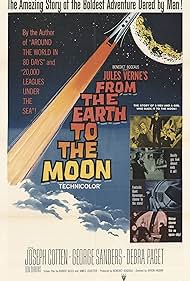
Set just after the American civil war, businessman and inventor Victor Barbicane invents a new source of power called Power X. He plans to use it to power rockets, and to show its potential he plans to send a projectile to the moon. Joining him for the trip are his assistant Ben Sharpe, Barbicane's arch-rival Stuyvesant Nicholl, and Nicholl's daughter Virginia. Nicholl believes that Power X goes against the will of God and sabotages the projectile so that they cannot return to earth, setting up a suspenseful finale as they battle to repair the projectile. Written by
Anonymous
Plot Summary
|
Add Synopsis
Taglines:
The Amazing Story of the Boldest Adventure Dared by Man!
Edit
Did You Know?
Goofs
Just before the spaceship is launched, someone shouts that the red warning rocket has been fired. But when the rocket explodes, its color is white.
See more »
Connections
References
Forbidden Planet (1956)
See more »
Soundtracks
"Electronic Tonalities"
(uncredited)
from
Forbidden Planet
composed by
Bebe Barron and
Louis Barron
heard during the scenes on board the rocket
See more »
This 1959 movie adaptation of Jules Verne's "From the Earth to the Moon" is the graveyard of declining actors. Joseph Cotton and George Sanders were at the end of fairly successful film careers and about to be relegated to guest appearances on a variety of television shows; the most notable being Sander's Mr. Freeze on "Batman". Debra Paget was in her late twenties; she had lost her glow and was used up by Hollywood standards. The change to an unflattering "strawberry" blonde look exacerbated the problem as few actresses have ever been less suited to a light hair color.
On the plus side, the movie itself is a fairly accurate adaptation of Verne's story; at least the book's illustrations appear to have been used as models for the rocket and the cannon. Verne's 19th century take on space travel turned out to be more accurate than most of the speculation during the first half of the 20th century.
The adaptation's biggest problem was altering Verne's story by inserting a topical theme about the post WWII arms race. In Verne's 1865 novel, the Baltimore Gun Club itself set about building a rocket to go to the Moon. In the adaptation a munitions manufacturer (think "Destination Moon") concocts the scheme to demonstrate his powerful new explosive. With a lot of discussion about science, weapons, and peace the movie dances around the subject extensively yet never makes a coherent point about its position (regarding the nuclear arms race), as if simply inserting the theme is somehow sufficient.
The movie is a cross between "Destination Moon" and "Rocketship X-M", combining the former's good science and bad political message with the latter's dismal sets and comical special effects. The acting in all three films is equally sad.
The premise has munitions manufacturer Victor Barbicane (Cotton) discovering an explosive (Power X) capable of firing a shell-like projectile to the moon. His plan is opposed for philosophical/religious reasons by Stuyvesant Nicholl (Sanders), another manufacturer. Although these philosophical differences play an important part in the story, they are never convincingly elaborated on, which undermines the basic storyline.
President Grant orders Barbicane to abandon the project because it is considered an act of war by other nations. While this is unconvincing it does serve as Barbicane's inspiration to change the project to a manned space flight. Nicholl then agrees to manufacture the ceramic coating needed for re-entry and to accompany Barbicane on a flight to the moon. Paget plays Nicholl's daughter who hides inside the rocket just prior to take-off.
"From the Earth to the Moon" is often confused with "First Men in the Moon" which was made five years later. Probably because both are set in the 19th century and both feature a female stowaway (played by Martha Hyer in the later film). "First Men in the Moon" (while not a great film) is superior in virtually every detail to "From the Earth to the Moon". Rather ironically it was adapted from a story by "H.G. Wells", an early science fiction writer often compared to Verne.
Movie adaptations of Verne's books were a big thing in the 1950's and early 1960's. Among the good ones were "20,000 Leagues Under the Sea" (1954), "Around the World in 80 Days" (1956), "Journey to the Center of the Earth"(1959), "Mysterious Island" (1961), and "Master of the World" (1961). Unfortunately "From the Earth to the Moon" is simply not in the same league as these examples.
Then again, what do I know? I'm only a child.