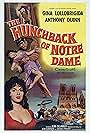
And I'll tell you why. It's not because of the dubbing (it's a foreign film and once you accept that, you can look past it). It's not because of the budget (it was 1956). It's because the film was horribly miscast & had a horrible script. If their intention was to be faithful, then they left out a lot of crucial parts and really messed up Esmeralda's character. For a tragic story, this movie is way too colorful. The ironic thing is that some of the previous and subsequent film versions, that sugar coated this story, look darker. Anthony Quinn; a good actor, so what happened? Why does Quasimodo look nothing like how he is described in the book? He played Quasimodo like a mutant ape man, who's hardly deformed, and not even hunched over, nor does he have a hump. Well he does have a hump (if one could call it that). But the fact of the matter is, he still looks like Anthony Quinn. Chaney, Laughton, Hopkins, & Patinkin were all unrecognizable. There was also no big dramatic reveal of him in Quasimodo costume. Gina Lollibrigida; I thought Esmeralda was supposed to be a 16 year old virgin French girl, that was kidnapped, and raised by gypsies? In this film, she looks like a 36 year old tavern wench. She over acts, and some of the dancing sequences are embarrassingly bad. They're long, her singing voice is almost of a baritone quality, she sings too low and out of her range, and, for a short moment, she stops dancing, laughs at the crowd, and then goes back to dancing. What the f*** was that? Another sequence that really irritated me (and wasn't even in the book) was when she first spots Quasimodo (not afraid of his features mind you, but later in the bell tower she is?) points out to the crowd and says, "Look! Look at his ugly face?" In order to crown him king of fools. Alain Cuny; Now, Victor Hugo had a knack for writing really great villains. In the novel Frollo was such a beautifully written, multi-facet character. Alain Cuny ALWAYS has the same expressionless look on his face, and not once do we ever get the scene where Frollo pours his heart out to Esmeralda in the dungeon, that scene (which is in the book) defines Frollo's character and makes the viewer able to understand and sympathize with him. But again, Cuny ALWAYS has the same stone look on his face. Even Vampira in "Plan 9 from Outer Space" had at least one different expression. No, not Cuny. All he does is just mope around. Derek Jacobi nailed it when he played Frollo, Richard Harris almost got it, and with Sir Cedrick Hardwick, you could tell that occasionally he would be troubled by his conscious, it was in his eyes and in his delivery. This Frollo is more like a grouchy kid in a playground who doesn't want to talk to any of the other kids. And what's worse, they changed his character to an Alchemist and nothing more. And even then, what is an Alchemist doing inside Notre-Dame? If he's not serving the church in anyway, why is he there? When the character is changed to a judge, at least it is a suitable and cautious change. When it's priest, it's faithful. But what is he in this version? And why does Frollo spread his arms out, and "let" Quasimodo through him over the cathedral? The actor playing Gringoire contributes a lot of embarrassing moments by injecting a lot of unneeded, and inappropriate, slapstick humor and over acting. The actor playing Clopin; doesn't display any kind of leadership skills. He's such a scrawny looking thing that one wonders, how did he become a leader of cutthroats. I always imagined Clopin to be a little more tough and intimidating looking. It's as if they cast Paul from the "Wonder Years" to play the king of thieves. The actor playing Phoebus was too sympathetic and not so much a "player" or "womanizer" as he was in the novel, or the 1939 & 82 versions. Now for the direction: The big scenes, such as the flogging, the trial, the rescue from the gallows, and the storming of the cathedral, were all executed very poorly. The more action oriented scenes were very slow paced and did not have any sort of dramatic music resulting in some very non-rousing sequences. In every film version, including the silent one, you either want to cry or feel very sorry for Quasimodo when he is flogged. This is the only version where I could not express any kind of emotion. And I've seen them all, even the bad ones. Not once do you ever feel sorry for Quasimodo in this film. The only scene that even comes close is when he hits his head on "Big Marie" after he's scared Esmeralda (who wasn't scared of him earlier in the film). Why didn't they use dialog from the book like so many other versions? The ending is the only thing in this film's defense. But... Even the ending was poorly executed. If you ever read the book, you either want to burst into tears or just kill yourself. Here, for some strange reason, you don't feel anything, and Esmeralda's death happens a little too quick and you become unaffected by her demise. And even then, they changed the way how she died and eliminated a very important character, as well as eliminating any mention of Esmeralda's real background. Should you avoid this at all costs? To me, this film did not "feel" like "The Hunchback of Notre-Dame" (aka "Notre-Dame De Paris"). But it should be viewed at least once, to see how bad it is.