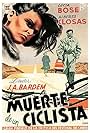
Death of a Cyclist
(1955)
|
|
| 0Share... |
Death of a Cyclist
(1955)
|
|
| 0Share... |
| Cast overview, first billed only: | |||
|
|
Lucia Bosé | ... |
María José de Castro
(as Lucia Bose)
|
|
|
Alberto Closas | ... |
Juan Fernández Soler
|
|
|
Bruna Corrà | ... |
Matilde Luque Carvajal
(as Bruna Corra)
|
|
|
Carlos Casaravilla | ... |
Rafael Sandoval dicho Rafa
|
|
|
Otello Toso | ... |
Miguel Castro
|
|
|
Alicia Romay | ... |
Carmina
|
|
|
Julia Delgado Caro | ... |
Doña Maria
|
|
|
Matilde Muñoz Sampedro | ... |
Vecina del ciclista muerto
|
|
|
Mercedes Albert | ... |
Cristina
|
|
|
José Sepúlveda | ... |
Comisario
(as Jose Sepulveda)
|
|
|
José Prada | ... |
Decano
(as Jose Prada)
|
|
|
Fernando Sancho | ... |
Sargento policía tráfico
|
|
|
Manuel Alexandre | ... |
Ciclista
|
|
|
Jacinto San Emeterio |
|
|
|
|
Manuel Arbó | ... |
P. Iturioz
(as Manuel Arbo)
|
Juan is an academic, his career stalled, teaching at the university because of his brother-in-law's prestige. María José is a socialite, married to wealth, bored but attached to her comforts. The two are lovers. On an isolated country road, their car strikes a cyclist; fearing exposure, they leave him to die. Distracted, Juan unjustly fails a student. Rafa, a bitter savant in their social circle, hints that he knows something, and he threatens to expose them to María José's husband, Miguel. Miguel's pride may be the lovers' best hope. Then Juan proposes a solution. Written by <jhailey@hotmail.com>
A mix of noir psychological thriller and political examination of class and privilege in Franco's Spain, this reminded me as much as anything of Antonioni's 'Story of a Love Affair', although I liked this even more. For me there were more thematic and emotional levels explored in more interesting ways.
The film is beautifully made with a striking use of transitions to keep us off base, and an alternating mix of neo-realist, and slick Hitchcockian camera work that evokes the separation of class in society.
The story is simple. A pair of upper-class lovers accidentally hit a cyclist on the highway, and leave him to die, for fear of being discovered as lovers and losing all they have in society and with each other.
The rest of the film is about both the moral questions of responsibility and ego versus a sense of communal responsibility, and the gut wracking tension as to whether the two will be discovered.
I was occasionally bothered by the heavy handedness of some of the film. Sometimes it was just a too on-the-nose politically ironic line, but particularly an important sub-plot about a student the male half of our anti-hero couple, has treated unfairly. This sub-plot, while beautifully shot and well acted, feels like it exists only to make political and thematic points, and pulled me out of identifying with the film on a human level. Likewise, a couple of crucial character twists, while interesting, feel forced or sudden -- more there to make a point then to honestly continue the narrative.
But these are small flaws compared to the film's great strengths, and it is very much worth seeing.