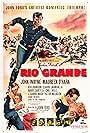
Rio Grande takes place after the Civil War when the Union turned their attention towards the Apaches. Union officer Kirby Yorke is in charge of an outpost on the Rio Grande in which he is ... See full summary »
Keep track of everything you watch; tell your friends.
If your account is linked with Facebook and you have turned on sharing, this will show up in your activity feed. If not, you can turn on sharing
here
.
The town of Warlock is plagued by a gang of thugs, leading the inhabitants to hire Clay Blaisdell, a famous gunman, to act as marshal. When Blaisdell appears, he is accompanied by his ... See full summary »
Director:
Edward Dmytryk
Stars:
Richard Widmark,
Henry Fonda,
Anthony Quinn
Aging cowboy Will Penny gets a line camp job on a large cattle spread and finds his isolated cabin is already occupied by a husbandless woman and her young son.
Director:
Tom Gries
Stars:
Charlton Heston,
Joan Hackett,
Donald Pleasence
In 1871, professional gambler John Devlin elopes with Sandra "Sandy" Poli, daughter of Marko Poli, an immigrant who has risen to railroad tycoon. Sandy, knowing that the railroad is to be ... See full summary »
Duke falls for Flaxen in the Barbary Coast in turn-of-the-century San Francisco. He loses money to crooked gambler Tito, goes home and PL: learns to gamble, and returns. After he makes a ... See full summary »
A renowned former army scout is hired by ranchers to hunt down rustlers but finds himself on trial for the murder of a boy when he carries out his job too well. Tom Horn finds that the ... See full summary »
Director:
William Wiard
Stars:
Steve McQueen,
Linda Evans,
Richard Farnsworth
Quirt Evens an all round bad guy is nursed back to health and sought after by Penelope Worth a quaker girl. He eventually finds himself having to choose from his world or the world from which Penelope lives by.
Arriving at Medicine Bow, eastern schoolteacher Molly Woods meets two cowboys, irresponsible Steve and the "Virginian," who gets off on the wrong foot with her. To add to his troubles, the ... See full summary »
When transplanted Texan Bob Seton arrives in Lawrence, Kansas he finds much to like about the place, especially Mary McCloud, daughter of the local banker. Politics is in the air however. ... See full summary »
Posing as a hangman, Mace Bishop arrives in town with the intention of freeing a gang of outlaws, including his brother, from the gallows. Mace urges his younger brother to give up crime. ... See full summary »
Rio Grande takes place after the Civil War when the Union turned their attention towards the Apaches. Union officer Kirby Yorke is in charge of an outpost on the Rio Grande in which he is in charge of training of new recruits one of which is his son whom he hasn't seen in 15 years. He whips him into shape to take on the Apaches but not before his mother shows up to take him out of there.The decision to leave is left up to Trooper Yorke who decides to stay and fight. Through it all Kirby and Kathleen though separated for years fall back into love and decide that it's time to give it another try. But Yorke faces his toughest battle when his unorthodox plan to outwit the elusive Apaches leads to possible court- martial. Locked in a bloody Indian war, he must fight to redeem his honor and save the love and lives of his broken family Written by
Christopher D. Ryan <cryan@direct.ca>
Ben Johnson (Tyree) and Victor McLaglen (Quincannon) had the same character names in both this film and She Wore a Yellow Ribbon. The oddity is in "She Wore a Yellow Ribbon"--released before this one-- they were older soldiers with higher ranks than in this film. See more »
Goofs
Obvious shadow of boom mic on ground behind Lt. Colonel Yorke, from 27:44 to 27:55, during conversation of Kathleen calling Quincannon an arsonist. See more »
As a writer, I find this to be the most honest and least pretentious of all John Ford's western films. His cavalry trilogy ended with "Rio Grande" (the others are "Fort Apache" and "She Wore a Yellow Ribbon: and it was also the first pairing of John Wayne with Maureen O'Hara, with whom he made five film appearances all told. The setting of the film is not glamorous by anyone's standards; it is dusty, hot, remote, a country for hard men and hard duty. The storyline has Wayne in command of a fort. When his son is assigned to him for training with other recruits, his wife, estranged for fifteen years, follows him--to try to meddle... The storyline makes clear that during the Civil War he refused to disobey orders to burn down her family's plantation; now she's come west, and he wants her back and want to instill his pride in and love for the cavalry in his son. There is rough humor in the film, changes to mind and body, learning to ride, standing up to the elements and to men, lessons the West can demand of anyone who comes there. nd after a plan of Wayne's to protect settlers against the Indians backfires, he has to risk everything to save his career and his command. The theme of the film is that any man has to dare and dream beyond old conventions and ideas in order to reach his best; and that goes for O'Hara as well. The film was directed by John Ford, with script by James Kevin MacGuinness..Bert Glennon's skilled B/W cinematography captures the bleak beauty of the spare semi-desert country, and admirably. Frank Hotaling did the production design and Victor Young contributed the score. In this feature's large cast were Wane, O'Hara. Claude Jarman Jr. of "The Yearling" as their son, Harry Carey Jr., Victor Maclaglen, J Carrol Naish, Chill Wills and many solid western performers. But the best thing to me about the production is the absence of any attempt to glamorize or apologize for the West. The men who rode for the cavalry lived with loneliness, the roughness of the country they patrolled and constant danger from those they opposed; this film makes it clear why men would do this for the meager pay they received; that it was the challenge they took up, as a way to use their abilities and emotional strength to the full. That is why I like this film the best of all of Ford's estimable works.
13 of 17 people found this review helpful.
Was this review helpful to you?
As a writer, I find this to be the most honest and least pretentious of all John Ford's western films. His cavalry trilogy ended with "Rio Grande" (the others are "Fort Apache" and "She Wore a Yellow Ribbon: and it was also the first pairing of John Wayne with Maureen O'Hara, with whom he made five film appearances all told. The setting of the film is not glamorous by anyone's standards; it is dusty, hot, remote, a country for hard men and hard duty. The storyline has Wayne in command of a fort. When his son is assigned to him for training with other recruits, his wife, estranged for fifteen years, follows him--to try to meddle... The storyline makes clear that during the Civil War he refused to disobey orders to burn down her family's plantation; now she's come west, and he wants her back and want to instill his pride in and love for the cavalry in his son. There is rough humor in the film, changes to mind and body, learning to ride, standing up to the elements and to men, lessons the West can demand of anyone who comes there. nd after a plan of Wayne's to protect settlers against the Indians backfires, he has to risk everything to save his career and his command. The theme of the film is that any man has to dare and dream beyond old conventions and ideas in order to reach his best; and that goes for O'Hara as well. The film was directed by John Ford, with script by James Kevin MacGuinness..Bert Glennon's skilled B/W cinematography captures the bleak beauty of the spare semi-desert country, and admirably. Frank Hotaling did the production design and Victor Young contributed the score. In this feature's large cast were Wane, O'Hara. Claude Jarman Jr. of "The Yearling" as their son, Harry Carey Jr., Victor Maclaglen, J Carrol Naish, Chill Wills and many solid western performers. But the best thing to me about the production is the absence of any attempt to glamorize or apologize for the West. The men who rode for the cavalry lived with loneliness, the roughness of the country they patrolled and constant danger from those they opposed; this film makes it clear why men would do this for the meager pay they received; that it was the challenge they took up, as a way to use their abilities and emotional strength to the full. That is why I like this film the best of all of Ford's estimable works.