Prison
(1949)
|
|
| 0Share... |
Prison
(1949)
|
|
| 0Share... |
| Complete credited cast: | |||
|
|
Doris Svedlund | ... |
Birgitta Carolina Soederberg
|
|
|
Birger Malmsten | ... |
Thomas
|
|
|
Eva Henning | ... |
Sofi
|
|
|
Hasse Ekman | ... |
Martin Grande
|
|
|
Stig Olin | ... |
Peter
|
|
|
Irma Christenson | ... |
Linnea
|
|
|
Anders Henrikson | ... |
Paul
|
|
|
Marianne Löfgren | ... |
Mrs. Bohlin
|
|
|
Bibi Lindqvist | ... |
Anna
|
|
|
Curt Masreliez | ... |
Alf
|
| Rest of cast listed alphabetically: | |||
|
|
Britta Holmberg | ... |
Birgitta's Mother in Dream
(voice)
|
A movie director is approached by his old math teacher with a great movie idea: the Devil declares that the Earth is hell. The director rejects the idea, but subsequent events in the life of a writer, a friend of the director's, and a young prostitute he loves seem to prove the math teacher's idea. Written by Erik Gregersen <erik@astro.as.utexas.edu>
This is an astonishing piece of work proving that Bergman had a clearly defined set of aesthetic ideas from very early in his career. The idea of the silence of god, the meaningless nature of life and consequently (and tragically) of art, the communication blocks dominating most of human relations and the epiphanic character of dreams. What distinguishes this movie most is it's very elaborated construction. For its 75 minutes the movie consists of layers upon layers of meaning that tend to make the whole thing cumbersome.
Right at the beginning we hear the sound of a gong such as those used sometimes in theaters to mark the introduction to an act. The same sound is heard at the very end when some of the characters presented as making a movie themselves exit the studio after a day's work and the lights go off. This is an intentionally ambiguous construction since we are left to wonder whether everything that's happened is "real" in whatever sense of the word we might look at the whole action. The beginning and ending seem to say that what we are watching should be looked at as a play, but after a couple of minutes of the film that introduce the plot, Bergman's voice is heard narrating not within the film (as it happens with Welles in his movies) but about the film per se similar to what Godard did more than a decade later in Le Mepris. After establishing the setting of the plot Bergman's voice makes room for it's development. Everything appears to go smoothly in terms of plot but the viewer is tempted to consider everything in the key provided at the beginning by one of the characters who talks about making a film that shows what would happen if the devil ruled the world. We are also introduced to a subplot involving the making of a film. This subplot will be used to comment on the main plot and draw the conclusions at the end, before the final gong. And if all of this was not enough, we are also shown parts of the film that is being produced and at one point two of the characters watch a short silent comedy that can be seen as giving clues to the larger picture.
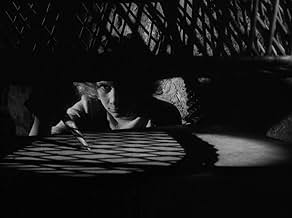
The cinematography (before Nykvist) is very well done, especially in a very good dream sequence (even better than the one in Wild Strawberries). And even if the movie as a whole may appear too experimental it still manages to pose a number of problems that not only make it watchable but it is highly recommended for any person who enjoys movies about movies such as Persona, 8 1/2, Le Mepris, , Mulholland Dr. etc.