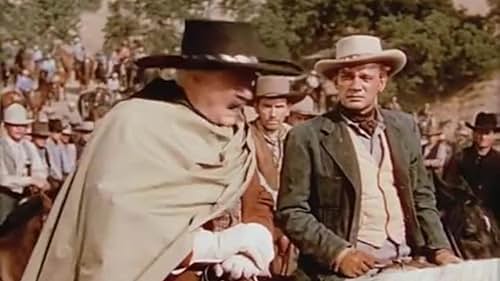
Released in 1946 and directed by King Vidor, "Duel in the Sun" stars Gregory Peck and Joseph Cotton as two rival sons of a ranch baron (Lionel Barrymore) in West Texas in the 1880s. When a striking half-breed (Jennifer Jones) comes to live on the ranch, she inspires love in the mild-mannered, educated son (Cotton) and unpredictable lust in the mocking, wild one (Peck). Lillian Gish plays the mother stuck in the middle while Walter Huston appears as a semi-questionable minister known as The Sinkiller. Charles Bickford is on hand as an older man also interested in the drama mama.
While the movie runs 2 hours and 24 minutes, a full 16 minutes is opening and ending music, which makes the runtime of the story itself just over 2 hours. Speaking of the opening "Prelude" and "Overture," the music (by Dimitri Tiomkin) is thoroughly passé and goes on way too long at 12 minutes before the credits, which last another 1:35. If you can get past that, though, this is a great old Western where the producers pulled out all the stops to entertain. Producer, writer and (uncredited) director David O. Selznick's ambition was to top "King Kong" (1933) and, particularly, "Gone with the Wind" (1939), two other pictures he produced.
Although critics fittingly dubbed it "Lust in the Dust," the movie WAS popular with the masses, no doubt helped by its controversial sexual content (which is tame today) and Selznick's affair with Jones, which broke up both of their marriages. They got married a few years later and it lasted till his death in 1965. Despite its box office success, "Duel" couldn't top "Gone with the Wind" and, being the most expensive film ever made at that point, it only broke even, although it eventually went on to make a profit with a re-release in 1954, etc.
Jones is notable as the heavy-breathing babe, but I personally prefer Joan Tetzel as the fiancé of the older son (Cotton). Also, Peck plays the bad son surprisingly well, considering how he's known for playing more noble protagonists, e.g. "The Big Country" (1958) and "Mackenna's Gold" (1969).
Bottom line: "Duel in the Sun" was just too big of a production to lose. Its story, while decidedly melodramatic, is compelling from beginning to end and there are highlights spiced throughout, including some stunning cinematography, amusing moments with horses and a couple of almost shocking sequences and story turns (e.g. the shootout in the saloon and, later, on the town street). To be expected, there are also some lowlights, but the movie always quickly recovers and maintains its footing. Lastly, there's a valuable moral hidden within the Western soap operatic shenanigans.
The film was shot in Arizona & California (too many places to list). The script was written by David O. Selznick & Oliver H.P. Garrett (and, uncredited, Ben Hecht) suggested by a novel by Niven Busch. ADDITIONAL CAST: Herbert Marshall, Harry Carey, Scott McKay & Butterfly McQueen.
GRADE: A