Keep track of everything you watch; tell your friends.
If your account is linked with Facebook and you have turned on sharing, this will show up in your activity feed. If not, you can turn on sharing
here
.
An American scientist publicly defects to East Germany as part of a cloak and dagger mission to find the solution for a formula resin and then figuring out a plan to escape back to the West.
A Scotland Yard undercover detective is on the trail of a saboteur who is part of a plot to set off a bomb in London. But when the detective's cover is blown, the plot begins to unravel.
Director:
Alfred Hitchcock
Stars:
Sylvia Sidney,
Oskar Homolka,
Desmond Tester
A man in London tries to help a counterespionage agent. But when the agent is killed and he stands accused, he must go on the run to both save himself and also stop a spy ring trying to steal top secret information.
Director:
Alfred Hitchcock
Stars:
Robert Donat,
Madeleine Carroll,
Lucie Mannheim
A mysterious, tall blonde woman, wearing dark sunglasses murders one of a psychiatrist's patients, and now she goes after the high-priced call girl who witnessed the murder.
Director:
Brian De Palma
Stars:
Michael Caine,
Angie Dickinson,
Nancy Allen
The population of a small, isolated countryside village believe that their alliance with the mysterious creatures that inhabit the forest around them is coming to an end.
Director:
M. Night Shyamalan
Stars:
Bryce Dallas Howard,
Joaquin Phoenix,
William Hurt
A murder inside the Louvre and clues in Da Vinci paintings lead to the discovery of a religious mystery protected by a secret society for two thousand years -- which could shake the foundations of Christianity.
Los Angeles aircraft worker Barry Kane evades arrest after he is unjustly accused of sabotage. Following leads, he travels across the country to New York trying to clear his name by exposing a gang of fascist-supporting saboteurs led by apparently respectable Charles Tobin. Along the way, he involves Pat Martin, eventually preventing another major act of sabotage. They finally catch up with Frank Frye, the man who actually committed the act of sabotage at the aircraft factory. Written by
alfiehitchie
While at Deep Springs Ranch, when Barry Kane is playing catch with baby Susie, the position of the balls on the seat change positions in between shots. See more »
Quotes
[to Barry Kane]
Charles Tobin:
Very pretty speech - youthful, passionate, idealistic. Need I remind you that you are the fugitive from justice, not I. I'm a promient citizen, widely respected. You are an obscure workman wanted fro committing an extremely unpopular crime. Now which of us do you think the police will believe?
See more »
"Columbia, the Gem of the Ocean"
(1843) (uncredited)
Music by David T. Shaw
Arranged by Thomas A. Beckett
Played by a band at the ship launching See more »
The story is spelled out elsewhere -- Cummings being mistaken for a saboteur and getting mixed up with a real gang -- so I'll pretty much skip it and just add a few comments.
First, it's identifiably Hitchcock, but is an example of his lighthearted thrillers not his more ambitious dramas. Think of it as being in the same class as, say, "The Lady Vanishes" or "North by Northwest." Aside from a speech Robert Cummings makes to the Nazis at the mansion -- about "you and your kind" -- none of this is meant to be taken very seriously.
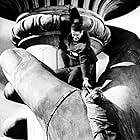
This is also the first use Hitchcock makes of an American landmark or even an identifiable American landscape in his films. It isn't his first use of landmarks as setting for a chase, since he earlier used the British Museum. He does better here with his mockup of the Statue of Liberty, which also carries a (rather heavy) symbolic weight.
The score is kind of sweet and musically a little tricky, but there is no music at all while Cummings is holding the villain Norman Loyd by the sleeve at the top of the statue. The scene cries out for explosive dramatic suspenseful collossal stupendous orchestration -- and Hitchcock keeps it silent except for a few whispered words from Loyd.
The plot has more holes than a slice of Swiss cheese but it doesn't matter much. "The FBI arrived at my ranch," says the suave Otto Krueger. "Luckily I was just leaving." The mother of the victim at the beginning seems to believe that Cummings, the victim's best friend, may have deliberately murdered him. A hole has been drilled in the wall of a deserted shack so that Cummings can find a telescope and look through the hole and see what appears to be Boulder Dam and cotton to what's going on. Oh, well.
The makeup department should have been penalized (or drafted). In some scenes Cummings is so plastered with makeup that he resembles a silent screen hero like Valentino. And sometimes the delectably cream-fed Priscilla Lane looks almost ordinary.
The best performances are from Otto Krueger, who switched from music to acting, fortunately, and from Alan Baxter as the soft spoken and not entirely unsympathetic heavy. We first see Baxter as he enters the abandoned shack at Soda City with Clem Bevins, brushing the dust fussily from the sleeve of his dark jacket. And he has a truly amazing conversation with Cummings in the back seat of a car while they are being driven to New York. It's a complete non sequitur dealing with Baxter's two young sons. He describes them lovingly and then talks about how much he wanted a girl. He asks Cummings if it would be acceptable to raise a boy nowadays with long hair, adding that when he himself was a child he had beautiful long golden curls. "You might do the kid a favor if you got him a haircut," advises Cummings! It's sometimes easy to make fun of Hitchcock and call him nothing more than a successful commercial hack, but it's almost impossible to imagine scenes like these appearing in another director's work, not with such consistency.
As far as that goes, few other directors would have the imagination to roll the credits against a blank wall and, afterwards, have an ominous black shadow of smoke unfurl itself against that background. But that's only visual flair. Not that it should be dismissed, but that conversation between Cummings and Baxter I think tells us much more about what exercised Hitchcock's interest aside from patterns on a silver screen.
20 of 27 people found this review helpful.
Was this review helpful to you?
The story is spelled out elsewhere -- Cummings being mistaken for a saboteur and getting mixed up with a real gang -- so I'll pretty much skip it and just add a few comments.
First, it's identifiably Hitchcock, but is an example of his lighthearted thrillers not his more ambitious dramas. Think of it as being in the same class as, say, "The Lady Vanishes" or "North by Northwest." Aside from a speech Robert Cummings makes to the Nazis at the mansion -- about "you and your kind" -- none of this is meant to be taken very seriously.
This is also the first use Hitchcock makes of an American landmark or even an identifiable American landscape in his films. It isn't his first use of landmarks as setting for a chase, since he earlier used the British Museum. He does better here with his mockup of the Statue of Liberty, which also carries a (rather heavy) symbolic weight.
The score is kind of sweet and musically a little tricky, but there is no music at all while Cummings is holding the villain Norman Loyd by the sleeve at the top of the statue. The scene cries out for explosive dramatic suspenseful collossal stupendous orchestration -- and Hitchcock keeps it silent except for a few whispered words from Loyd.
The plot has more holes than a slice of Swiss cheese but it doesn't matter much. "The FBI arrived at my ranch," says the suave Otto Krueger. "Luckily I was just leaving." The mother of the victim at the beginning seems to believe that Cummings, the victim's best friend, may have deliberately murdered him. A hole has been drilled in the wall of a deserted shack so that Cummings can find a telescope and look through the hole and see what appears to be Boulder Dam and cotton to what's going on. Oh, well.
The makeup department should have been penalized (or drafted). In some scenes Cummings is so plastered with makeup that he resembles a silent screen hero like Valentino. And sometimes the delectably cream-fed Priscilla Lane looks almost ordinary.
The best performances are from Otto Krueger, who switched from music to acting, fortunately, and from Alan Baxter as the soft spoken and not entirely unsympathetic heavy. We first see Baxter as he enters the abandoned shack at Soda City with Clem Bevins, brushing the dust fussily from the sleeve of his dark jacket. And he has a truly amazing conversation with Cummings in the back seat of a car while they are being driven to New York. It's a complete non sequitur dealing with Baxter's two young sons. He describes them lovingly and then talks about how much he wanted a girl. He asks Cummings if it would be acceptable to raise a boy nowadays with long hair, adding that when he himself was a child he had beautiful long golden curls. "You might do the kid a favor if you got him a haircut," advises Cummings! It's sometimes easy to make fun of Hitchcock and call him nothing more than a successful commercial hack, but it's almost impossible to imagine scenes like these appearing in another director's work, not with such consistency.
As far as that goes, few other directors would have the imagination to roll the credits against a blank wall and, afterwards, have an ominous black shadow of smoke unfurl itself against that background. But that's only visual flair. Not that it should be dismissed, but that conversation between Cummings and Baxter I think tells us much more about what exercised Hitchcock's interest aside from patterns on a silver screen.