Jimmy Connors and his girl-friend want to take part in Paul Whiteman's highschool's band contest, but they cannot afford the fare. But per chance the meet Paul Whiteman in person and are ... See full summary »
Keep track of everything you watch; tell your friends.
If your account is linked with Facebook and you have turned on sharing, this will show up in your activity feed. If not, you can turn on sharing
here
.
Jimmy Connors and his girl-friend want to take part in Paul Whiteman's highschool's band contest, but they cannot afford the fare. But per chance the meet Paul Whiteman in person and are able to convince him, that their band is good enought, so he lents sem the money. But then one of their friends becomes seriously ill and had to be carried in a hospital per plane, they had to use Whiteman's money for this. Written by
Stephan Eichenberg <eichenbe@fak-cbg.tu-muenchen.de>
"Lux Radio Theater" broadcast a 60 minute radio adaptation of the movie on October 28, 1940 with Judy Garland and Mickey Rooney reprising their film roles. See more »
Goofs
Jimmy Conners claims to have gone to Chicago for the World Series three years before. The World Series is always played at the home stadiums of the competing teams and the 1937 series was between the New York Yankees and the New York Giants. The 1938 World Series was indeed between the Chicago Cubs and the New York Yankees, but that would have been only two years before the film was released. See more »
Quotes
Paul Whiteman:
Take that boy on the street. Teach him to blow a horn and he'll never blow a safe.
See more »
After the success of Babes In Arms for MGM, Arthur Freed became the hottest producer on the lot and was granted his own famous Freed Unit to produce the best of the MGM musicals for the next 20 years almost. According to Hugh Fordin's book on Arthur Freed the next scheduled property was Good News, but that got shelved for several years when Louis B. Mayer decided that a patriotic type theme was in order and after all MGM had bought the screen rights to the Gershwin musical Strike Up The Band. Freed agreed, but in the Hollywood tradition only the title and the title song were retained for the screen.
That was enough because the Mickey and Judy formula was by now established with Babes In Arms. Here the two are a pair of talented musical kids and Mickey is the drummer in his high school band. But he's got other things on his mind besides doing John Philip Sousa. Even Sousa did more than Sousa when he was leading a band. Mickey is filled with the new jive rhythms of the day and he'd like to use the other kids in the school orchestra to form a real band. He's got Garland in mind for the vocals and the object is to get an audition from Paul Whiteman.
Whiteman in his day may have appropriated for himself the title of King Of Jazz, but certainly no one did more to popularize the new American art form among white audiences. His orchestra was the training ground for many of later big band leaders. Leaders like Tommy and Jimmy Dorsey and Glenn Miller all who were sidemen with Whiteman and who kids like Mickey and Judy and the rest of the cast were listening to.
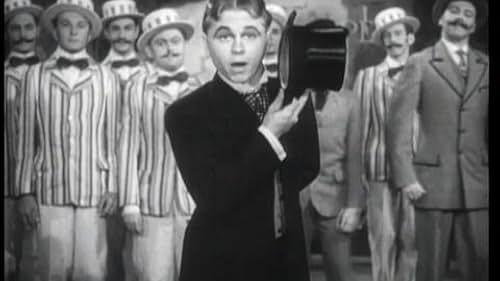
If Strike Up The Band isn't exactly let's put on a show, it still is let's put on a concert and Mickey and Judy do have some shtick to perform, their Gay Nineties spoof is quite good. Also the fantasy sequence of the 'fruit orchestra' doing Our Love Affair is also nicely done, it looks very much like Ray Harryhausen's claymation figures, but he wasn't involved with Strike Up The Band.
Strike Up The Band won one Academy Award for sound and was nominated for two others. Roger Edens and Arthur Freed wrote Our Love Affair which was nominated for Best Song, but lost to When You Wish Upon A Star. And Edens and Georgie Stoll were nominated for Best Musical Scoring.
Busby Berkeley directed the film and in the finale shows his fine hand for spectacle. Here's where the patriotism that Louis B. Mayer was seeking came out. Remember this was 1940 and a lot of people were very afraid the USA was going into another World War. The finale with the title song was the kind of rousing patriotic spectacle that Hollywood would be doing in every studio after December 7, 1941.
With Strike Up The Band Arthur Freed proved he was no flash in the pan as a producer. After 70 years the film holds up well and the talents of Mickey Rooney and Judy Garland reign eternal.
5 of 6 people found this review helpful.
Was this review helpful to you?
After the success of Babes In Arms for MGM, Arthur Freed became the hottest producer on the lot and was granted his own famous Freed Unit to produce the best of the MGM musicals for the next 20 years almost. According to Hugh Fordin's book on Arthur Freed the next scheduled property was Good News, but that got shelved for several years when Louis B. Mayer decided that a patriotic type theme was in order and after all MGM had bought the screen rights to the Gershwin musical Strike Up The Band. Freed agreed, but in the Hollywood tradition only the title and the title song were retained for the screen.
That was enough because the Mickey and Judy formula was by now established with Babes In Arms. Here the two are a pair of talented musical kids and Mickey is the drummer in his high school band. But he's got other things on his mind besides doing John Philip Sousa. Even Sousa did more than Sousa when he was leading a band. Mickey is filled with the new jive rhythms of the day and he'd like to use the other kids in the school orchestra to form a real band. He's got Garland in mind for the vocals and the object is to get an audition from Paul Whiteman.
Whiteman in his day may have appropriated for himself the title of King Of Jazz, but certainly no one did more to popularize the new American art form among white audiences. His orchestra was the training ground for many of later big band leaders. Leaders like Tommy and Jimmy Dorsey and Glenn Miller all who were sidemen with Whiteman and who kids like Mickey and Judy and the rest of the cast were listening to.
If Strike Up The Band isn't exactly let's put on a show, it still is let's put on a concert and Mickey and Judy do have some shtick to perform, their Gay Nineties spoof is quite good. Also the fantasy sequence of the 'fruit orchestra' doing Our Love Affair is also nicely done, it looks very much like Ray Harryhausen's claymation figures, but he wasn't involved with Strike Up The Band.
Strike Up The Band won one Academy Award for sound and was nominated for two others. Roger Edens and Arthur Freed wrote Our Love Affair which was nominated for Best Song, but lost to When You Wish Upon A Star. And Edens and Georgie Stoll were nominated for Best Musical Scoring.
Busby Berkeley directed the film and in the finale shows his fine hand for spectacle. Here's where the patriotism that Louis B. Mayer was seeking came out. Remember this was 1940 and a lot of people were very afraid the USA was going into another World War. The finale with the title song was the kind of rousing patriotic spectacle that Hollywood would be doing in every studio after December 7, 1941.
With Strike Up The Band Arthur Freed proved he was no flash in the pan as a producer. After 70 years the film holds up well and the talents of Mickey Rooney and Judy Garland reign eternal.