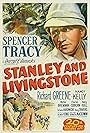
Stanley and Livingstone is an elaborate 1939 American adventure film directed by Henry King and Otto Brower. It is loosely based on the true story of determinated Welsh reporter Sir Henry M. Stanley's (Spencer Tracy) quest to find Dr. David Livingstone (Sir Cedric Hardwicke) , a Scottish missionary presumed lost in Africa, who finally met on November 10, 1871. This is the entertaining , attractive and legendary true-story of detailing the obsessive search for find a missionary by a savage land American . As journalist Tracy sets out into darkest Africa to locate a long lost British explorer . As Stanley carries out a tumultuous expedition that gains new life in this handsomely produced account . All the world no show like this! He succeeded in the maddest quest in History...because one girl believed in him! A woman he never could have . Inspired him to complete the greatest adventure the world has ever kown ! "Find Livingstone" The command that sent Stanley on the most stirring adventure ever known! The most heroic exploit the world has known !. Into the perilous wilderness of unknown Africa...one white man ventured to seek another! Heat...fever...cannibals...jungle...nothing could stop him!
This is a spectacular film set at turn of century with beautifully understated interpretations , containing adventure , action , romance , thrills and historical events .The classic Hollywood kistch version of the Victorian legend-based-on-fact . Being a lavish and dramatically solid fictionalized history . The interesting story of two strangers who made good friends and being competently performed . Spencer Tracy plays Stanley , while Cedric Hardwicke portrays Livingstone. Other cast members include Nancy Kelly, Richard Greene, Walter Brennan, Charles Coburn , Henry Travers and Henry Hull. Special mention for starring Spencer Tracy who's magnificent , as usual and low-key . The motion picture was competently directed by Henry Koster .
The film is based on actual events from these two great explorers : Stanley travelled to Zanzibar in March 1871, later claiming that he outfitted an expedition with 192 porters and many of his porters deserted, and the rest were decimated by tropical diseases. Stanley found David Livingstone on 10 November 1871 in Ujiji, near Lake Tanganyika in present-day Tanzania. He later claimed to have greeted him with the now-famous line, "Dr. Livingstone, I presume?" However, this line does not appear in his journal from the time-the two pages directly following the recording of his initial spotting of Livingstone were torn out of the journal at some point-and it is likely that Stanley simply embellished the pithy line sometime afterwards. Neither man mentioned it in any of the letters they wrote at this time, and Livingstone tended to instead recount the reaction of his servant, Susi, who cried out: "An Englishman coming! I see him! . Stanley joined Livingstone in exploring the region, finding that there was no connection between Lake Tanganyika and the Nile. On his return, he wrote a book about his experiences . In 1874, the New York Herald and the Daily Telegraph financed Stanley on another expedition to Africa. His ambitious objective was to complete the exploration and mapping of the Central African Great Lakes and rivers, in the process circumnavigating Lakes Victoria and Tanganyika and locating the source of the Nile. Between 1875 and 1876 Stanley succeeded in the first part of his objective, establishing that Lake Victoria had only a single outlet - the one discovered by John Hanning Speke on 21 July 1862 and named Ripon Falls. If this was not the Nile's source, then the separate massive northward flowing river called by Livingstone, the Lualaba, and mapped by him in its upper reaches, might flow on north to connect with the Nile via Lake Albert and thus be the primary source. Between November 1876 and August 1877, Stanley and his men navigated the Lualaba up to and beyond the point where it turned sharply westward, away from the Nile, identifying itself as the Congo River. Stanley and his men reached the Portuguese outpost of Boma, around 100 kilometres from the mouth of the Congo River on the Atlantic Ocean, after 999 days on 9 August 1877. Stanley's diary show that he started with 228 people and reached Boma with 114 survivors, with he being the only European left alive out of four. Stanley was approached by King Leopold II of the Belgians, the monarch who had already established the International African Association (a front organization for the later International Association of the Congo) at the Brussels Geographic Conference of 1876. Stanley first hoped to continue his pioneering work in Africa under the British flag. But neither the Foreign Office nor Edward, the Prince of Wales, felt called to receive Stanley after the many rumors of his looting and killing in the interior of the African continent. Leopold II eagerly received a disenchanted Stanley at his palace in June 1878, and signed a contract with him.