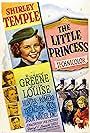
The Little Princess (1939) 7.0
A little girl is left by her father in an exclusive seminary for girls, due to her father having to go to Africa with the army. Director:Walter Lang |
|
| 0Share... |
The Little Princess (1939) 7.0
A little girl is left by her father in an exclusive seminary for girls, due to her father having to go to Africa with the army. Director:Walter Lang |
|
| 0Share... |
| Cast overview, first billed only: | |||
| Shirley Temple | ... | ||
|
|
Richard Greene | ... | |
| Anita Louise | ... |
Rose
|
|
|
|
Ian Hunter | ... | |
| Cesar Romero | ... | ||
|
|
Arthur Treacher | ... | |
| Mary Nash | ... | ||
|
|
Sybil Jason | ... | |
|
|
Miles Mander | ... |
Lord Wickham
|
|
|
Marcia Mae Jones | ... | |
|
|
Beryl Mercer | ... | |
|
|
Deidre Gale | ... | |
|
|
Ira Stevens | ... | |
|
|
E.E. Clive | ... | |
|
|
Eily Malyon | ... | |
When her father, Captain Crewe, goes off to fight in the Boer War, young Sara Crewe is placed into the care of Amanda Minchin, the head of an exclusive private school for girls. Sara lives a wonderful life of a privileged child and is quite happy in her surroundings. When her father is listed as missing in action however, her life goes from one of plenty to that of a poor house maid. Mrs. Minchin agrees to keep her on at the school, but in the absence of her tuition payments, she has to work for her keep. She is soon cleaning out the fireplace and scrubbing floors and is dubbed the little princess by her former schoolmates. She also refuses to accept that her father is dead and prowls the hospitals in the hope of locating him. Luck - and Royal intervention - assist her in her quest. Written by garykmcd
"The Little Princess" is a reversal-of-fortune movie, so to speak. Sarah Crewe (Shirley Temple) is the daughter of a wealthy soldier sent off to the Boer War in 1899. Having no relatives, Sarah is placed in an exclusive girls school until her father returns. When her father is reported dead and their fortune is wiped out, the friendly headmistress becomes not-so-friendly towards Sarah, who is made to work off her father's debt to the school. Sarah is convinced that her father is alive, though, and searches the area hospital for him, eventually finding him.
This movie serves as an excellent example of several things: movies like this just aren't made any more. Unfortunately, they can't be - people would say it was too corny. In the movie, Shirley portrays a child not only with unshakable hope but patience, manners, politeness and kindness in the face of terrible adversity, with only a couple of cracks in her steadfastness. She meets Queen Victoria. Who would believe that a child under the duress that she suffers could be so gracious? Who would believe that, being a pauper, she could meet the Queen of England? Today's movie child star would have filled the air with sassiness and expletives under the same situation. But Shirley/Sarah doesn't, and that's a reason that I really like this movie
- it shows someone who tries to make the best of a bad situation, and never
gives up hope.I also believe that the movie is an accurate portrayal of the life and times of the turn of the century, as it was made only 40 years after the Boer War. I think that Victorian England was captured well in this movie; after all, we do a pretty good job of displaying the 1960s on film these days.
Overall, though, it is Shirley Temple at her singing/dancing/acting best in this movie, and she does a wonderful job from start to finish.