Keep track of everything you watch; tell your friends.
If your account is linked with Facebook and you have turned on sharing, this will show up in your activity feed. If not, you can turn on sharing
here
.
A flamboyant Broadway impresario who has fallen on hard times tries to get his former lover, now a Hollywood diva, to return and resurrect his failing career.
Director:
Howard Hawks
Stars:
John Barrymore,
Carole Lombard,
Walter Connolly
While trying to secure a $1 million donation for his museum, a befuddled paleontologist is pursued by a flighty and often irritating heiress and her pet leopard "Baby."
Director:
Howard Hawks
Stars:
Katharine Hepburn,
Cary Grant,
Charles Ruggles
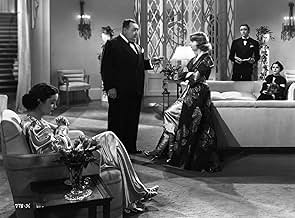
In the depths of the Depression, a party game brings dizzy socialite Irene Bullock to the city dump where she meets Godfrey, a derelict, and ends by hiring him as family butler. He finds the Bullocks to be the epitome of idle rich, and nutty as the proverbial fruitcake. Soon, the dramatizing Irene is in love with her 'protege'...who feels strongly that a romance between servant and employer is out of place, regardless of that servant's mysterious past... Written by
Rod Crawford <puffinus@u.washington.edu>
The failure of the original copyright holder to renew the film's copyright resulted in it falling into public domain, meaning that virtually anyone could duplicate and sell a VHS/DVD copy of the film. Therefore, many of the versions of this film available on the market are either severely (and usually badly) edited and/or of extremely poor quality, having been duped from second- or third-generation (or more) copies of the film. See more »
Goofs
In the living room scene just after the PARK AVENUE CHATTER column that appears, Cornelia's magazine changes. At first, Cornelia picks up a magazine having a dark stripe along the top and bottom of the front cover, then the magazine has a lighter front cover and a woman (resembling her) in an ad on the back cover. As Cornelia moves over to the couch, the magazine changes back to the original one; further, it reveals a star shape on the front cover and a non-portrait on the back cover. See more »
Quotes
Molly:
Mr. Bullock, there's a hansom cab driver waiting to see you in the kitchen.
Alexander Bullock:
What's he want?
Molly:
He wants $50 and his horse.
Alexander Bullock:
What horse?
Molly:
The one Miss Irene rode up the front steps last night.
Alexander Bullock:
Where is his horse? I haven't got it!
Molly:
It's in the library, where Miss Irene left it.
See more »
Crazy Credits
The opening credits features a darkened city skyline and the names of the cast and crew appear as the camera pans across lighted billboards and neon signs. See more »
The great depression of the 30s, in a way, created inequality in this country. On the one hand, great fortunes were made and many more were lost. In those days Hollywood's idea for escapism was the screwball comedy, with an emphasis in presenting how the privileged classes lived. This was in sharp contrast with what the majority of regular citizens were experiencing.
With that background, Gregory La Cava, a man who knew how to entertain an audience, took the direction of "My Man Godfrey". In the film we are given, on the one hand, what appears to be a city dump near to Sutton Place, one of the richest areas in Manhattan. We are shown a destitute man, Godfrey, who comes in contact with a couple of rich girls out on a scavenger hunt. Godfrey will change their lives forever.
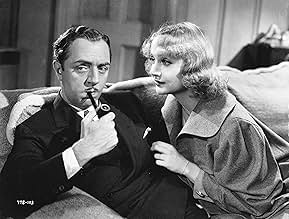
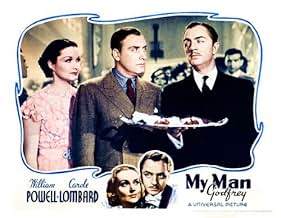
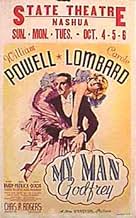
"My Man Godfrey" gathered a distinguished cast. William Powell and Carole Lombard were at the pinnacle of their popularity. Both actors exuded charisma in any film they graced with their charming presence. They both left a mark of distinction in this comedy. Both are elegant and sophisticated, and they make us care about the characters they are playing.
The best thing about those 30s comedies were the marvelous ensemble casts assembled to support the stars. Thus, one is treated to delicious performances by Gail Patrick, Eugene Palette, Alice Brady, Micha Auer, Jean Dixon and Alan Mowbray.
This is a classic film that will live forever.
38 of 46 people found this review helpful.
Was this review helpful to you?
The great depression of the 30s, in a way, created inequality in this country. On the one hand, great fortunes were made and many more were lost. In those days Hollywood's idea for escapism was the screwball comedy, with an emphasis in presenting how the privileged classes lived. This was in sharp contrast with what the majority of regular citizens were experiencing.
With that background, Gregory La Cava, a man who knew how to entertain an audience, took the direction of "My Man Godfrey". In the film we are given, on the one hand, what appears to be a city dump near to Sutton Place, one of the richest areas in Manhattan. We are shown a destitute man, Godfrey, who comes in contact with a couple of rich girls out on a scavenger hunt. Godfrey will change their lives forever.
"My Man Godfrey" gathered a distinguished cast. William Powell and Carole Lombard were at the pinnacle of their popularity. Both actors exuded charisma in any film they graced with their charming presence. They both left a mark of distinction in this comedy. Both are elegant and sophisticated, and they make us care about the characters they are playing.
The best thing about those 30s comedies were the marvelous ensemble casts assembled to support the stars. Thus, one is treated to delicious performances by Gail Patrick, Eugene Palette, Alice Brady, Micha Auer, Jean Dixon and Alan Mowbray.
This is a classic film that will live forever.