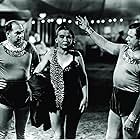
A circus' beautiful trapeze artist agrees to marry the leader of side-show performers, but his deformed friends discover she is only marrying him for his inheritance.
Keep track of everything you watch; tell your friends.
If your account is linked with Facebook and you have turned on sharing, this will show up in your activity feed. If not, you can turn on sharing
here
.
While vacationing on a remote Scandanavian island with his younger pregnant wife, an artist has a emotional breakdown while confronting his repressed desires.
During a secretive business trip away, Mark learns that his wife Anna is growing restless in what he believed was their happy marriage. Upon his return home, he learns from her that she ... See full summary »
Director:
Andrzej Zulawski
Stars:
Isabelle Adjani,
Sam Neill,
Margit Carstensen
Two death-obsessed sisters, outcasts in their suburban neighborhood, must deal with the tragic consequences when one of them is bitten by a deadly werewolf.
A young couple move into a new apartment, only to be surrounded by peculiar neighbors and occurrences. When the wife becomes mysteriously pregnant, paranoia over the safety of her unborn child begins controlling her life.
A practical man returns to his homeland, is attacked by a creature of folklore, and infected with a horrific disease his disciplined mind tells him can not possibly exist.
Director:
George Waggner
Stars:
Lon Chaney Jr.,
Claude Rains,
Ralph Bellamy
In the first shot after the "Wedding Feast" title card, we see Daisy and Violet playing soprano saxophones, but we only hear a harmonica being played. See more »
Quotes
Frieda:
It wasn't your fault, it was only the bottle you wanted.
See more »
Part fictional portrait of a group of circus sideshow performers and part tragic soap opera about their various and complicated relationships, the main story has a midget, Hans (Harry Earles), falling in love with the Amazonian trapeze artist, Cleopatra (Olga Baclanova), who feigns affection for him--at first to taunt him and later to use him.
Freaks isn't really a horror film, although the horror boom that began in 1931 precipitated Freaks entering production. The script developed out of an earlier one named "Spurs" that had been in MGM's possession since the late 1920s. The success of Universal's horror films of 1931 (Dracula and Frankenstein) had studios scrambling to cash in on the trend. Horror films weren't new, of course, but repeated commercial success of horror films released in quick succession was. A number of factors contributed to the phenomenon, including the Great Depression, the lingering cultural impact from World War I, and the advent of sound films. So even though Freaks wasn't exactly horror, and the protagonists weren't exactly monsters, it was close enough. In the early 1930s, the public had not yet been overexposed to media-sensationalized differences in human appearances and behavior. The effect of the film then, in conjunction with memories of real life horrors, including those of war-mangled veterans, offered the emotional reaction that producers and studios are often seeking from horror films.
But Freaks is really part tragic drama, part character study, and in many ways it is almost a documentary. The modern attraction to the film comes from a few sources. One, the "gawking effect", or the simple fact of watching the freaks in action. Sideshows are an unfortunately dying phenomenon, if they're not already dead (many would say they are), largely because of a combination of medical advances, which often "cure" the physical differences that would have made "victims" sideshow candidates, and political correctness, which mistakenly sees sideshows as negatively exploitative. It's fascinating watching the different kinds of people in the film and their behavior, including not only their social interactions, but how some of them manage to just get around and perform everyday activities such as eating, lighting a cigarette, and so on. This kind of material takes up at least half of the film's short running time (64 minutes; initially it ran closer to 90 minutes, but 26 minutes of cuts were made (and are now apparently lost) to appease the New York State censor board).
Two, this was a lost film, figuratively and almost literally, for quite some time. MGM wanted nothing to do with it. For a while, it had been playing the "roadshow" circuit in different cuts, under different titles, such as "Nature's Mistakes". The film had been banned in many areas, and at least technically is still banned in some. It eventually appeared on VHS in the 1980s, but until the recent DVD release, it has never been very easy to find in most rental or retail outlets.
Three, the most common modern reading of the film--and this was also part of director Tod Browning's intention in making Freaks, even if the average audience member didn't see it this way at first, has it as a Nightbreed (1990)-like turning of the dramatic tables, where the extremely alienated "monsters" are the sympathetic protagonists and the ostensibly "normal" humans turn out to be the real monsters. For those who like films best where they can identify in some emotional way with the characters, Freaks is particularly attractive to anyone who feels alienated or strongly different, even looked down upon, by "normal" society. At various times, and by various people, Freaks has been read as everything from purely exploitative schlock to a socialist parable to a film imbued with odd commentary, metaphors and subtexts about male-female couplings and Oedipal complexes.
Freaks isn't a great film in terms of the usual criteria, such as storytelling, exquisite performances, and so on, but it's appropriate that it wouldn't be a masterpiece per the normal criteria--it's not about normal people. The film is certainly valuable as a creative, almost experimental artwork, not to mention as a more or less permanent record of the decayed and almost abandoned artform of sideshows. It's not surprising that not every cast member is an incredible actor--for many roles, there was only one person available who could have fulfilled the character in a particular way, making the stilted delivery of dialogue more excusable. In any event, this is an important film historically, and a joy to watch.
94 of 110 people found this review helpful.
Was this review helpful to you?
Part fictional portrait of a group of circus sideshow performers and part tragic soap opera about their various and complicated relationships, the main story has a midget, Hans (Harry Earles), falling in love with the Amazonian trapeze artist, Cleopatra (Olga Baclanova), who feigns affection for him--at first to taunt him and later to use him.
Freaks isn't really a horror film, although the horror boom that began in 1931 precipitated Freaks entering production. The script developed out of an earlier one named "Spurs" that had been in MGM's possession since the late 1920s. The success of Universal's horror films of 1931 (Dracula and Frankenstein) had studios scrambling to cash in on the trend. Horror films weren't new, of course, but repeated commercial success of horror films released in quick succession was. A number of factors contributed to the phenomenon, including the Great Depression, the lingering cultural impact from World War I, and the advent of sound films. So even though Freaks wasn't exactly horror, and the protagonists weren't exactly monsters, it was close enough. In the early 1930s, the public had not yet been overexposed to media-sensationalized differences in human appearances and behavior. The effect of the film then, in conjunction with memories of real life horrors, including those of war-mangled veterans, offered the emotional reaction that producers and studios are often seeking from horror films.
But Freaks is really part tragic drama, part character study, and in many ways it is almost a documentary. The modern attraction to the film comes from a few sources. One, the "gawking effect", or the simple fact of watching the freaks in action. Sideshows are an unfortunately dying phenomenon, if they're not already dead (many would say they are), largely because of a combination of medical advances, which often "cure" the physical differences that would have made "victims" sideshow candidates, and political correctness, which mistakenly sees sideshows as negatively exploitative. It's fascinating watching the different kinds of people in the film and their behavior, including not only their social interactions, but how some of them manage to just get around and perform everyday activities such as eating, lighting a cigarette, and so on. This kind of material takes up at least half of the film's short running time (64 minutes; initially it ran closer to 90 minutes, but 26 minutes of cuts were made (and are now apparently lost) to appease the New York State censor board).
Two, this was a lost film, figuratively and almost literally, for quite some time. MGM wanted nothing to do with it. For a while, it had been playing the "roadshow" circuit in different cuts, under different titles, such as "Nature's Mistakes". The film had been banned in many areas, and at least technically is still banned in some. It eventually appeared on VHS in the 1980s, but until the recent DVD release, it has never been very easy to find in most rental or retail outlets.
Three, the most common modern reading of the film--and this was also part of director Tod Browning's intention in making Freaks, even if the average audience member didn't see it this way at first, has it as a Nightbreed (1990)-like turning of the dramatic tables, where the extremely alienated "monsters" are the sympathetic protagonists and the ostensibly "normal" humans turn out to be the real monsters. For those who like films best where they can identify in some emotional way with the characters, Freaks is particularly attractive to anyone who feels alienated or strongly different, even looked down upon, by "normal" society. At various times, and by various people, Freaks has been read as everything from purely exploitative schlock to a socialist parable to a film imbued with odd commentary, metaphors and subtexts about male-female couplings and Oedipal complexes.
Freaks isn't a great film in terms of the usual criteria, such as storytelling, exquisite performances, and so on, but it's appropriate that it wouldn't be a masterpiece per the normal criteria--it's not about normal people. The film is certainly valuable as a creative, almost experimental artwork, not to mention as a more or less permanent record of the decayed and almost abandoned artform of sideshows. It's not surprising that not every cast member is an incredible actor--for many roles, there was only one person available who could have fulfilled the character in a particular way, making the stilted delivery of dialogue more excusable. In any event, this is an important film historically, and a joy to watch.