IMDb >
The Iron Horse (1924)
Watch It
Buy it at Amazon
Rent it at blockbuster.com
Discuss in Boards More at IMDb Pro Add to My Movies Update Data
BETA
Discuss in Boards More at IMDb Pro Add to My Movies Update Data
Quicklinks
Top Links
trailers and videosfull cast and crewtriviaofficial sitesmemorable quotesOverview
main detailscombined detailsfull cast and crewcompany creditstv scheduleAwards & Reviews
user commentsexternal reviewsnewsgroup reviewsawardsuser ratingsparents guiderecommendationsmessage boardPlot & Quotes
plot summaryplot synopsisplot keywordsAmazon.com summarymemorable quotesFun Stuff
triviagoofssoundtrack listingcrazy creditsalternate versionsmovie connectionsFAQOther Info
merchandising linksbox office/businessrelease datesfilming locationstechnical specslaserdisc detailsDVD detailsliterature listingsNewsDeskPromotional
taglines trailers and videos posters photo galleryExternal Links
showtimesofficial sitesmiscellaneousphotographssound clipsvideo clipsThe Iron Horse (1924) More at IMDbPro »
| Photos (see all 8 | slideshow) |
Overview
User Rating:
Release Date:
1925 (Germany) moreTagline:
Blazing the Trail of Love and Civilization morePlot:
Springfield, Illinois. Brandon, a surveyor, dreams of building a railway to the west, but Marsh, a contractor... more | add synopsisPlot Keywords:
User Comments:
"By superhuman effort and undaunted courage" moreCast
(Complete credited cast)| George O'Brien | ... | Davy Brandon | |
| Madge Bellamy | ... | Miriam Marsh | |
| Charles Edward Bull | ... | Abraham Lincoln | |
| Cyril Chadwick | ... | Peter Jesson | |
| Will Walling | ... | Thomas Marsh | |
| Francis Powers | ... | Sgt. Slattery | |
| J. Farrell MacDonald | ... | Cpl. Casey | |
| Jim Welch | ... | Pvt. Schultz (as James Welch) | |
| George Waggner | ... | Col. William F. 'Buffalo Bill' Cody | |
| Fred Kohler | ... | Bauman | |
| James A. Marcus | ... | Judge Haller (as James Marcus) | |
| Gladys Hulette | ... | Ruby |
Additional Details
Also Known As:
The Iron Trail (USA) (working title)The Trans-continental Railroad (USA) (working title)
more
Parents Guide:
Add content advisory for parentsRuntime:
133 minCountry:
USALanguage:
EnglishColor:
Black and White (tinted)Aspect Ratio:
1.33 : 1 moreSound Mix:
SilentCertification:
Sweden:15Fun Stuff
Trivia:
When on location, the crew built a large town set in which many of the buildings had practical rooms. These rooms soon became living quarters, holding areas and storage space. The editing lab was set up in the post office set. moreFAQ
This FAQ is empty. Add the first question.more
Message Boards
Discuss this movie with other users on IMDb message board for The Iron Horse (1924)Recommendations
If you enjoyed this title, our database also recommends:
Show more recommendations
|
|
|
|
|
| Vengeance - and the Woman | Ghost of Zorro | Red Fork Range | The Phantom Rider | Pony Express Days |
|
IMDb User Rating:
|
IMDb User Rating:
|
IMDb User Rating:
|
IMDb User Rating:
|
IMDb User Rating:
|
Related Links
| Full cast and crew | Company credits | External reviews |
| IMDb Western section | IMDb USA section | Add this title to MyMovies |


In the mid-1920s cinema saw the second coming of the epic, the first having been in the mid-1910s, and giants of the era such as Douglas Fairbanks and Cecil B. DeMille were continually upping the ante on each other with bigger and bigger pictures. Meanwhile the Western had been in gradual development, and by now it was only logical that this ever-popular genre was itself given a massiveness makeover. Paramount had the first stab with The Covered Wagon in 1923, and the following year Fox responded with The Iron Horse.
The Western itself of course went through many developments in theme, and can be grouped into different phases. The Iron Horse, along with Covered Wagon, Three Bad Men (1926) and The Big Trail (1930) belongs squarely to the "pioneer" Westerns which dominate this era. In these pictures the west would typically be an unclaimed wilderness, and the heroes were those who explored, settled and developed it. By now the genuine old west was fading from living memory, and so now we had the first generation for whom it could be a romanticised piece of history. Plus of course there is the fact that the wagon trails, railroads and cattle drives of the pioneer Western were ideal for the aforementioned fashion for epic pictures.
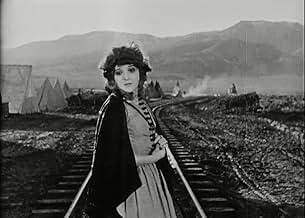
Today of course The Iron Horse is best remembered for its director a young John Ford. Even back then Ford had a close association with the Western, although to some extent his style is still in development here. His shot composition relies heavily on very distinctive framing devices such as tree branches or posts, and sometimes the shots look a little cluttered. Also, his approach to the romantic love scenes is entirely conventional with close-ups, rhyming angles and sparse backgrounds so as to focus on the actors. The older (more cynical?) John Ford tended to shoot these moments rather flatly, the camera hanging back, and even throwing in distracting background business.
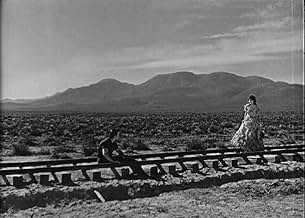
On the other hand, and perhaps in ways that matter more, this is very much the same John Ford of Stagecoach, Fort Apache and so forth. In particular is his vision of the west. Right from the opening scenes he contrasts the smallness of the homestead with the romantic allure of the wilderness framing the actors tightly in the opening shots, and then cutting to point-of-view shots of the trail. He always captures the vastness of the outdoors, and yet without ever dwarfing the people in it. Particularly impressive (and this is perhaps where Ford's greatest strength lay) is his ability to combine different storytelling elements in a single shot for example at one point we see a mother mourn her son at his grave in the foreground, while a heavily loaded train passes through in the background.
Another typically Fordian element is the precedence he gives to the comic relief characters. On location they were largely working without a script, so Ford could spin their scenes out as long as he wanted. As with many of his later pictures, charming though it is, the comedy business threatens to unbalance the real story. We can also see in "Drill ye terriers" a forerunner to the group singsong that is a staple of even the earliest John Ford talkies.
A nod to the actors is also due. This was George O'Brien's first lead role and he doesn't do badly, considering he got the part mainly for being a good-looking newcomer who could ride a horse. He doesn't emote too convincingly, but he moves well which is the most important thing for a picture like this. The other standout is J. Farrell MacDonald, who played the kind of roles for Ford in the silent era that would later be filled by Victor McLaglan in the talkies basically a comical Irish drunk. But like McLaglan he hid real dramatic talent under the act, and he emerges as the most genuine player in this piece.
Ford's confidence and passion for the genre make the Iron Horse a classic, but it's worth remembering that The Iron Horse is also a triumph of post-production. Cast and crew had gone on location without a complete shooting script and large chunks of it are more or less improvised. As well as directing Ford took one of his earliest credits of producer and, would thus have been able to continue supervising the product after shooting was over. It's hard to imagine what any other producer or editor would have made of the footage he brought back from location. It's unlikely they would have kept so much of the comic diversions and "oirishness", and it's perhaps with The Iron Horse that we have - for better or for worse - the earliest example of an unbridled John Ford.