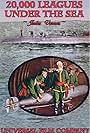
Captain Nemo has built a fantastic submarine for his mission of revenge. He has traveled over 20,000 leagues in search of Charles Denver - a man who caused the death of Princess Daaker. ... See full summary »
Keep track of everything you watch; tell your friends.
If your account is linked with Facebook and you have turned on sharing, this will show up in your activity feed. If not, you can turn on sharing
here
.
Captain Nemo has built a fantastic submarine for his mission of revenge. He has traveled over 20,000 leagues in search of Charles Denver - a man who caused the death of Princess Daaker. Seeing what he had done, Denver took the daughter to his yacht and sailed away. He abandoned her and a sailor on a mysterious island and has come back after all these years to see if she is still alive and if the nightmares he has will stop. The daughter has been found by five survivors of a Union Army Balloon that crashed near the island. At sea, Professor Aronnax was aboard the ship 'Abraham Lincoln' when Nemo rammed it and threw the Professor, his daughter and two others into the water. Prisoners at first, they are now treated as guests to view the underwater world and to hunt under the waves. Nemo will also tells them about the Nautilus and the revenge that has driven him for all these years. Written by
Tony Fontana <tony.fontana@spacebbs.com>
In one scene on the island the balloon survivors are at a table and a black servant appears. He never shows up again and is not rescued at the end of the film with the rest of the survivors. See more »
OK, this movie isn't at all faithful to Verne's novels (both 20000 leagues & Mysterious island), but who cares. It was too difficult for that time to stay close to the characters and to the relationship between Arronax and Nemo, which is based on the talking, showing different philosophical points of vue. So there we stick to a melodrama full of suspense and action. The pacing is quite fast, for a 1916 movie. A lot of characters and settings are involved, the cinematography is most of the time quite good and the actors are... so so. But it's the editing that attracts attention here, in a griffithian narration full of "parrallel editing" as we say in french. Some sequences are composed of four or five parallel actions, and sometimes flashbacks are used to add another dimension to the melodrama. The same fact is related three times by three different characters, each flashback being longer than its predecessor until the final revelation (that we can guess early in the film, but, as for most of gender movies, the pleasure for the viewer comes from the combination between waited events and surprising elements) narrated by Nemo himself. I don't know anything as for the origin of the version I own on DVD, so this editing question is to stay questioned. But as it is there (I saw the 1h45 version, a Jokanan copy), it's a really imaginative movie, a sort of serial with a complexer narration. It is sometimes a little boring anyway, especially when it deals with Arronax and co (Ned Land is useless, and the real hero of the movie arrives later on) and with submarine sequences (no so many, in fact, but a little childish sometimes). The documentary aspect is anyway interesting (the shark scene, an early Cousteau sequence) and from an historical point of view those sequences are very important.
A good movie, not as brilliant as the Fleischer version, but entertaining and representative of the evolution of American cinema at that time.
Just for the record: it's quite possible that the Nadia anime series by Anno Hideaki have been highly inspired by this movie (I won't say anything else, avoiding spoilers. Watch for yourself).
9 of 10 people found this review helpful.
Was this review helpful to you?
OK, this movie isn't at all faithful to Verne's novels (both 20000 leagues & Mysterious island), but who cares. It was too difficult for that time to stay close to the characters and to the relationship between Arronax and Nemo, which is based on the talking, showing different philosophical points of vue. So there we stick to a melodrama full of suspense and action. The pacing is quite fast, for a 1916 movie. A lot of characters and settings are involved, the cinematography is most of the time quite good and the actors are... so so. But it's the editing that attracts attention here, in a griffithian narration full of "parrallel editing" as we say in french. Some sequences are composed of four or five parallel actions, and sometimes flashbacks are used to add another dimension to the melodrama. The same fact is related three times by three different characters, each flashback being longer than its predecessor until the final revelation (that we can guess early in the film, but, as for most of gender movies, the pleasure for the viewer comes from the combination between waited events and surprising elements) narrated by Nemo himself. I don't know anything as for the origin of the version I own on DVD, so this editing question is to stay questioned. But as it is there (I saw the 1h45 version, a Jokanan copy), it's a really imaginative movie, a sort of serial with a complexer narration. It is sometimes a little boring anyway, especially when it deals with Arronax and co (Ned Land is useless, and the real hero of the movie arrives later on) and with submarine sequences (no so many, in fact, but a little childish sometimes). The documentary aspect is anyway interesting (the shark scene, an early Cousteau sequence) and from an historical point of view those sequences are very important.
A good movie, not as brilliant as the Fleischer version, but entertaining and representative of the evolution of American cinema at that time.
Just for the record: it's quite possible that the Nadia anime series by Anno Hideaki have been highly inspired by this movie (I won't say anything else, avoiding spoilers. Watch for yourself).